
Sometimes in investing, a stock is a better value at $20/share than it was at $10/share. Why? Often the stock is trading at $10/share because there’s some huge existential risk hanging over it, and it’s a better risk/reward at $20/share once that existential risk has been removed. After a wild year for SaaS stocks, I can’t help but wonder if that’s exactly what’s happening now with the sector.
How wild has the year been for SaaS? In mid-April, IGV (the software index ETF) bottomed down almost 30% YTD…. and, from those lows, it has climbed back to being slightly positive for the year.
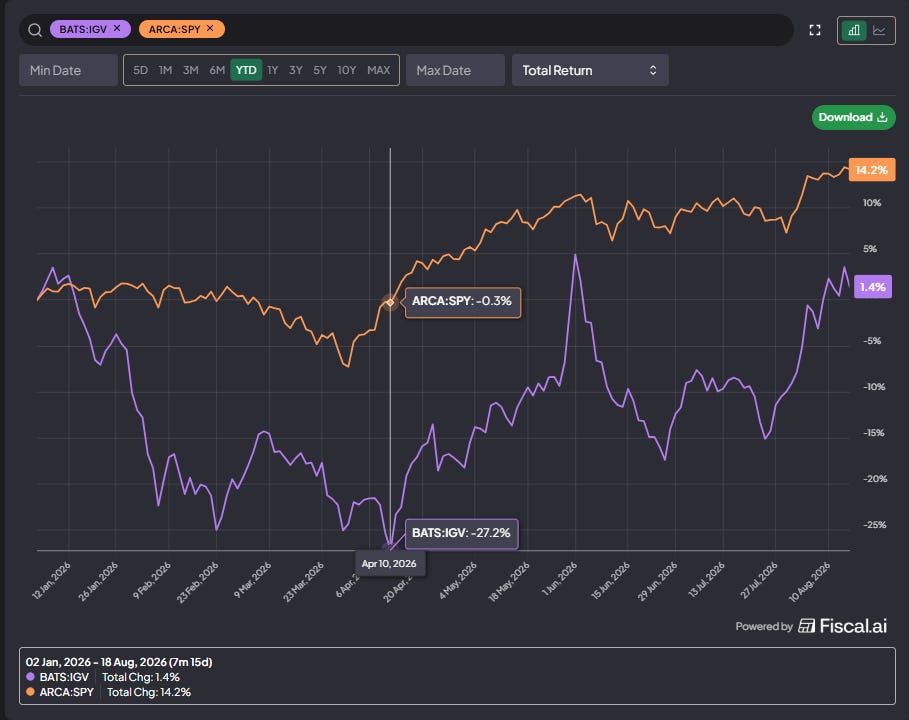
That chart probably slightly understates the pain in software. IGV is a reasonably concentrated ETF; the top 6 components each have weightings over 5% and make up just shy of 50% of the index in total:
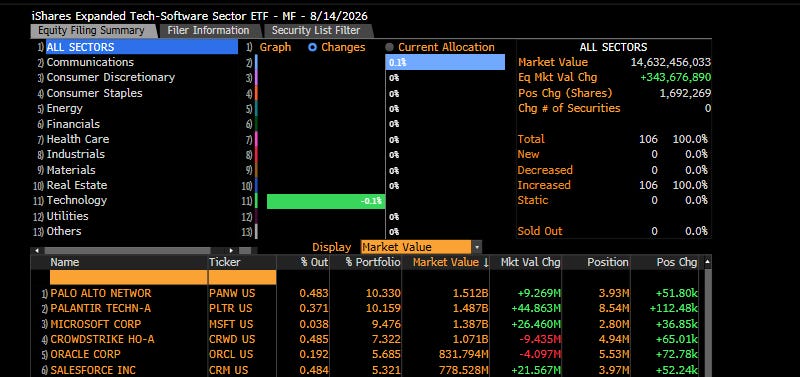
And two of IGV’s largest components (PANW and CRWD) are having banner years, with their stocks roughly doubling YTD.
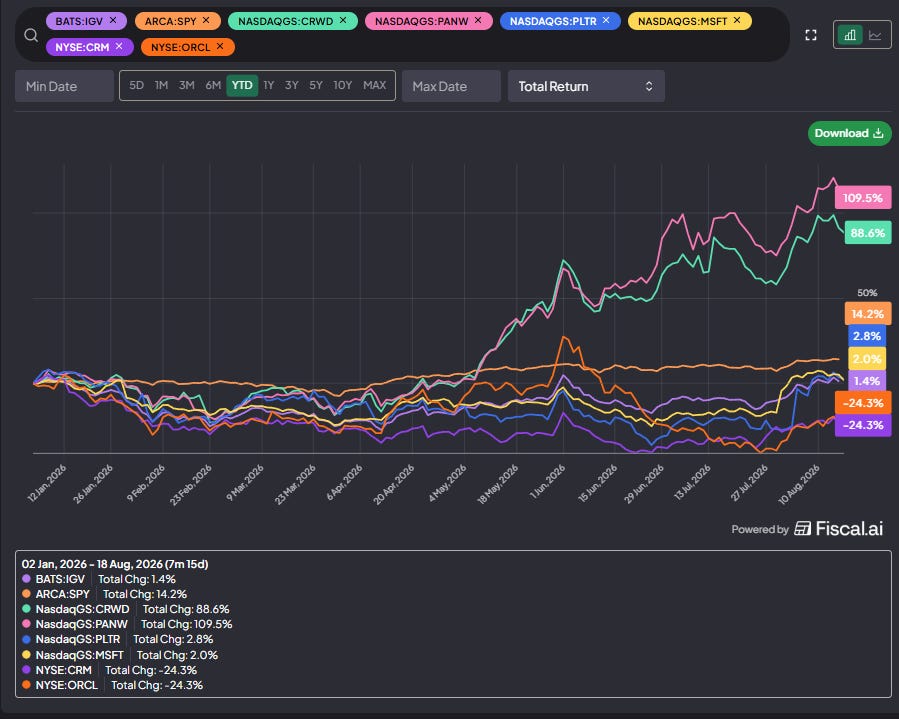
So while the outlook for software is certainly nowhere near as dire as it was back in February, your average SaaS company today is still probably down solidly on the year / trading cheaper than it has for most of the past decade.
Anyway, I’ve spent a lot of time thinking (and writing!) about the SaaSpocalypse this year. See, for example, my podcast with Marcelo Lima from April (almost literally the exact bottom!), or my “Some ramblings on the SaaSpocalypse” or “More SaaSpocalypse at $WIX” posts from February. Hindsight is 20/20, but it obviously would have been a great time to plow into software when I was writing those posts!!!
But this blog tries not to wallow in missed opportunity! Instead, let’s go back to the $20/share versus $10/share framing. Yes, all of the companies have bounced hard off the lows…. but we’ve got a lot of new information alongside that bounce, and all of that information suggests that worst case scenarios have basically been removed. Perhaps SaaS stocks are a case where they are better values today than they were at the height of the panic a few months ago?
What new information do investors have that they can look at and say “these stocks are cheaper at higher prices than they were a few months ago?” I’d point to two different things: earnings season reassurance the bottom isn’t falling out and private equity / M&A bids coming back to the space.
Let’s start with earnings. Q2 earnings season is generally over1, which means investors have had a chance to hear updated numbers and guidance from SaaS companies. This is painting with a very broad brush, but in general software companies have performed much better than feared when the SaaSpocalypse fears were really running rampant. Perhaps every company is going to replace all of their software with internal home brews in the future, but there’s no sign of it happening in the present (as was the fear at the height of the selloff). In fact, it might be just the opposite; a lot of SaaS companies are reporting strong demand for their products driven by the AI trends. Here are just a few examples of quotes from recent earnings releases:
NOW (7th largest IGV component): “exceptional Q2 results solidify our position as the fastest-growing major enterprise software and cybersecurity company”
I’m not claiming this is a comprehensive list, but you can kind of pick up and down the board for large software components and you’ll generally find companies guiding to continued strong demand even as AI ramps up. Again, not to say that the shoe won’t eventually drop here, but in the short term software companies’ strong results and guides have generally relieved the “everyone is going to home brew their own SaaS” fears.
The other interesting thing is M&A has come back to the software space in a big way, particularly private equity bids. The big one here is rumors broke last week that Silver Lake is in talks for WDAY; that would be a ~$50B take private and one of the largest software takeouts of all time (heck, you can drop software from that statement; it’d be one of the largest deals ever!). However, the potential WDAY / Silver Lake deal is far from the only one in the space. On the definitive deal side, we’ve seen:
Nielsen buying DV for $2.16b (30% premium)
Thoma Bravo buying ARX for >$4b (~50% premium)
Nuvei buying PAYO for $2.75b (this deal got leaked, but it was a ~44% premium to the pre-leak price)
WEAV2 getting bought by Francisco Partners for $650m (~35% premium)
To be fair, a few of these are software-adjacent more than pure SaaS, but the pattern is the same! Outside of those definitive deals, there have been a lot of rumored deals that I wouldn’t be surprised to see lead to deals in the near future:
CCC exploring a sale after Elliott builds stake
Note: As I was writing this article, news broke that CCC had multiple bidders, including Copart.
Why are all those deals / rumored deals interesting?
I’m long past believing that private equity is the smartest money in the room or anything. They’re just as prone to cyclical behavior and buying at the top as the rest of us! However, I think they can serve as a very useful signal in industries and theses where there is one obvious and very diligence-able bear point.
Why?
Because private equity has nearly unlimited due diligence budget to throw around running surveys and doing expert interviews to resolve how particular issues are trending. And they also have access to internal data (how their own portfolio companies are spending or responding to a risk) that no one else has.
And private equity doesn’t just need to get comfortable with risk points on their own. Because they generally need to raise debt for take privates, private equity needs to get lenders comfortable that there is real downside protection in these businesses. It’s one thing for a private equity firm to buy a company at a cheap multiple that’s facing terminal value questions (as SaaS is with AI). If they’re wrong, they could have a zero on their hands, but if they’re right they could have multi-bagger upside, so they can take a coin flip chance of a company going bust if the upside is high enough. In contrast, a lender’s upside is limited to their interest payments, so they’re going to be much more concerned with downside protection in a worst case scenario.
Put the two together, and I’d suggest that both the private equity firms and the lenders have internal data and due diligence metrics that have gotten them very comfortable with the terminal value risk for these companies. That’s not to say that they’re right or wrong, particularly if the AI trade accelerates even faster than it already has! It’s just that they’ve gotten comfortable with a very obvious risk, which suggests that (at worst) it’s been priced in and (at best) that the risk is diminishing.
So what’s the playbook from here? My guess is that SaaS is going to be a stock picker’s paradise for the next few quarters. There’s no doubt that some of these businesses are going to be heavily disrupted by AI, and those stocks will bleed out…. but there are plenty of businesses that are still trading at reasonable multiples that will be AI beneficiaries and potential PE takeout plays that the market is still skeptical of. As always, I’m sifting through possible candidates for this, and I may write some up in the near future.... but my inbox is always open if you have any candidates you think are worth looking at that you’d like to swap notes on!
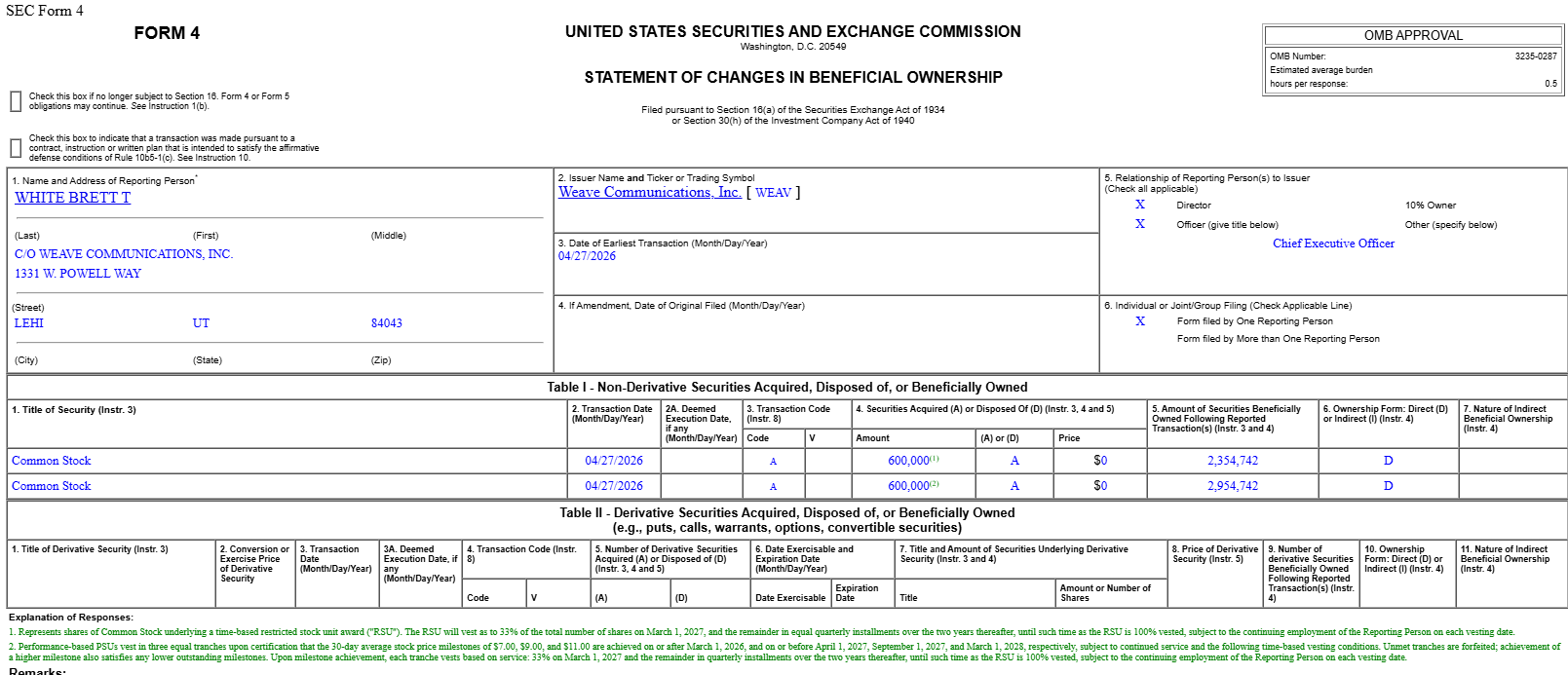
PS- I’d be remiss if I didn’t mention that both WDAY and WEAV gave out some dark arts style grants earlier this year….. perhaps insiders knew in real time that the stock price was too cheap and a private equity endgame was in the cards?

WEAV’s dark arts style grants:
Software companies report on weird cycles, so there are a few large software companies that are yet to report / will report in the next month. ORCL, CRM, INTU, etc.
Disclosure: I had a small position in WEAV. A frustratingly small position given the takeout.
Same logic played out in biotech after 2021. Names that cratered 80% got cheap on paper but stayed expensive on fundamentals until pipelines matured. Multiple compression only signals value once growth actually stabilizes, not before.
I pushed CSU so hard at the bottom!
Fantastic company.
Great of you to keep your mind open on the way up! That's hard to do.