
AI and its impact on investors has been a massive running theme of this blog over the past few months, and I’m currently of two minds on it.
On the one hand, I find AI fascinating; I’ve been using AI to quickly build interesting research tools (and even a new Substack!), and the process of playing with AI in different ways has been insanely fun and massively ramped my productivity.
On the other hand, I find AI terrifying. As an investor, you are paid for some combination of your judgement, analytical skills, and hard work. As AI continues to improve, I worry that AI undercuts humans on all three of those levels. Consider:
Hard work: Most professional investors get paid on some type of incentive fee. It’s comical to spell this out, but the whole purpose of the incentive fee is to incentivize the manager to work hard. So, consider the GOAT: Buffett. Last year, I reread Buffett’s Biography, the Snowball, for my book club. One thing that jumps out when you read it is just how hard Buffett worked1; there were tons of stories along the lines of “Buffett skipped XYZ family event to read one more annual report alone in his office.” The argument would be that investors in Buffett’s partnership gave him the money and the incentive fee to reward him for skipping that dinner and generating insane returns…. but what happens when you’ve got an AI running that can read every 10-k and every piece of investing material all the time. How is a human supposed to compete with that? No matter how large the fee, humans run into natural laws on how much they can read. A human needs to sleep; an AI does not. At the high end, a speed reader can comprehend 400-700 words per minute; AI basically has no limit. No amount of hard work or dedication will let a human catch up to the AI in terms of just quantity of information consumed.
Judgement: Like in most competitions, investors generally get better with experience. There’s just something about researching a bunch of companies and investing through a market cycle or two that makes you a better investor and gives you better judgement, and there’s no real way to shortcut the process… as a human. But an AI could run unlimited backtests and near instantly consume all of recorded market history. How is a human who is limited by their own market experiences supposed to compete with the whole of human history?
Analytical skills: When you think about a “top” investor, what generally makes them stand out is their analytical skills. They study a company or an industry, determine what future the market is pricing it for, and then swing when they think the market is wrong for XYZ reason. In math, AI has gone from unable to do basic math to “frighteningly smart” inside of a few years; how long until it can reason out industries and businesses better than any human could ever hope?
So I worry that the days of a human able to outperform the market are over… and my level of worry kind of goes up when I see things like META2 granting “YOLO” options that would likely require a massive acceleration in AI to pay off. And, while admitting that I may be prisoner to the moment, I’ll note that the SOXX going parabolic isn’t making me feel any better about my worries: yes, a parabolic move may just be part of a bubble forming…. but a parabolic move in semiconductor pricing is also what you’d expect if AI is starting to approach full AGI.
In fact, in my mind, if you’re an investor and you’re not at least somewhat worried about AI replacing humans, I’d argue you’re not thinking enough about the problem. AI has gotten so good at beating humans at every game it plays (chess, Go, Starcraft) that it stopped being newsworthy when AI conquered new games three or four years ago. If you’re an investor who is not worried at all about AI, you’re betting on one of two things:
You’re making an extremely binary bet that there’s something so unique about the markets (probably its fat tails) that AI can’t succeed in investing when it can at literally every other competitive field.
Personally, that’s not a bet I’m really eager to make.
People once worried that spreadsheets would kill off accounting jobs, but the rise of spreadsheets actually killed off the lower end jobs (bookkeeping) but created an explosion in more skilled roles like accountants and auditing. You’re hoping something like that happens here, and AI kills off lower end jobs (I guess entry level analyst?) but creates an explosion of higher end jobs (portfolio manager?).
I’ll admit: it’s not a perfectly clean comp, but you can see the kernels of some hope there.
I will also note that I’ve gotten a little hope recently from software engineers: despite the massive improvement in AI software coding, we haven’t seen mass layoffs of software engineers. Instead, we seem to be seeing companies stop hiring at the bottom (low end / entry level analysts), but higher end engineers seem to be holding on and maybe even increasing their value by harnessing AI to massively improve their productivity. I think the hope here would look something like this: AI supplants humans as an analyst, but the most talented investors learn how to harness AI to massively increase productivity / research speed while letting them really focus / differentiate with whatever their specific edge is.
What’s an investor to do if they’re acting rationally (at least in my opinion) and worried about the AI takeover? That is a hard question to answer. My wife and I used to joke that selling pictures of our feet online was always our backup gig…. but I suspect that if AI is good enough to solve ~100 year old math proofs and displace humans from investing, it will produce foot photos far more marketable than my own little piggies will ever be. Another popular option might be “drink away your worries,” but I don’t drink, so that’s not exactly an answer for me either!
With excessive drinking and profiting off my feet scratched off, the best option I can think of as an investor looking to insure against the rise of investing AI is a “Texas hedge”: buying stocks that would benefit from the rise of our AI overlords3.
What’s interesting is that putting on a Texas hedge actually isn’t that expensive right now. Yes, volatility on Micron and the like is off the charts, but those moves are being driven by shortages and super-cycle style profits. I struggle to believe that we live in a world where we have superpowered AI that can’t figure out how to respond to pricing signals to solve shortages over the medium term; if you’re buying one of those plays, you’re really just betting on how long (and how deep) the current shortages last. I don’t have any view on that.
But consider META and MSFT. It’s hard to imagine a world where you get a real AI takeoff and at least one of them isn’t a winner. On top of their own AI efforts, MSFT owns 27% of OpenAI (plus an insane amount of compute and hardware from Azure). META probably has more data than anyone on the planet plus their own (suddenly) promising AI efforts. Both trade for reasonable multiples (fiscal.ai tells me both are in the low 20s forward P/E) and have long-dated LEAPS that are reasonably liquid and pretty cheap: META’s December 2028 LEAPS have high 30s vol while MSFT’s are in the low 30s…. that seems way too low for businesses that could be on the verge of a massive AI inflection.
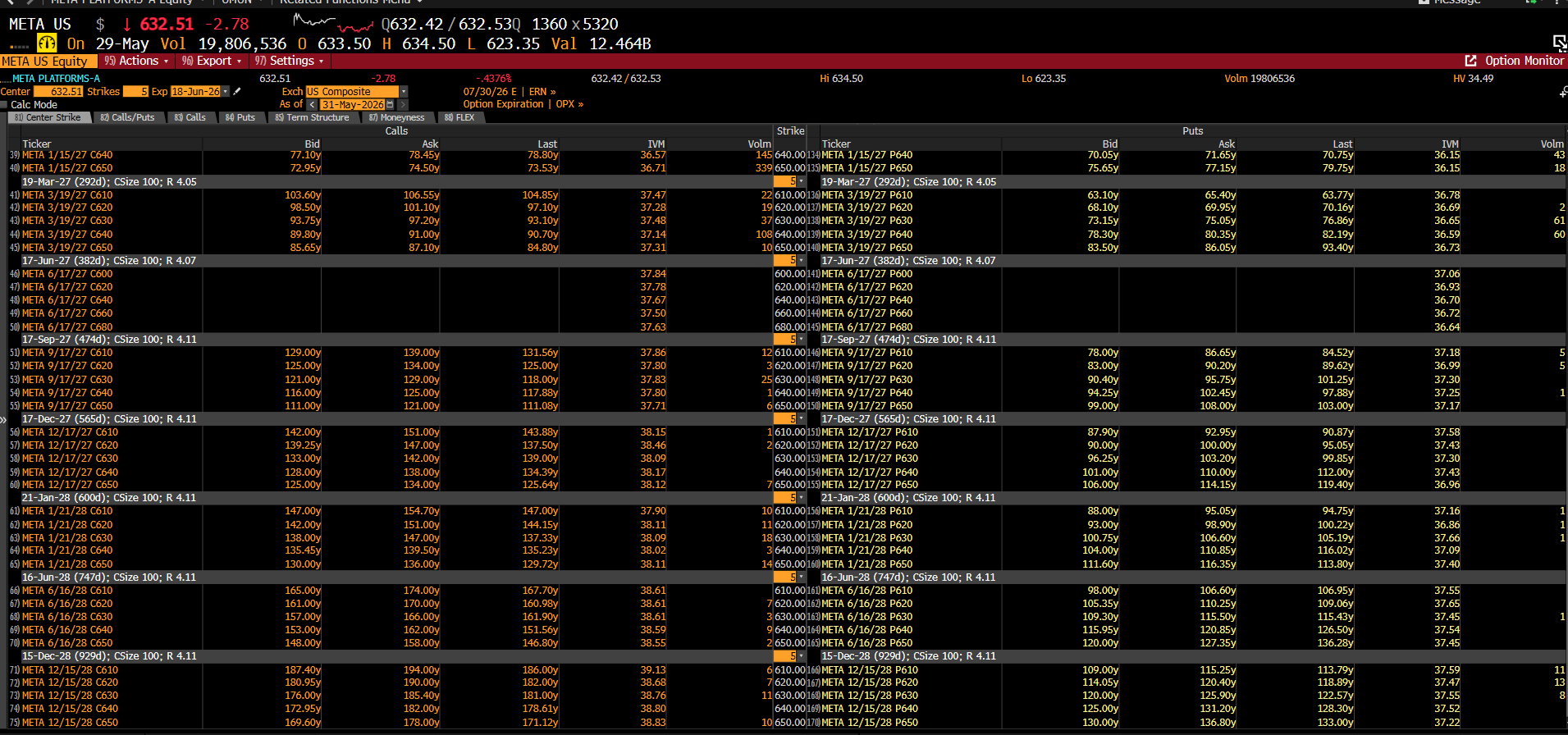
Maybe I’m suffering from AI psychosis…. but, to me, buying META / MSFT at around a market multiple with the added kicker that at least one of them probably goes parabolic if AI really takes off from here does not seem like a bad “hedge” on AI taking all of our jobs.
Note that I’d settled on MSFT and META as the “value” hedge (given their low multiples + AI exposure) to AI taking over the world a few weeks back…. but it’s interesting that they’re now two of Ackman’s largest positions (and that he basically sold Google to buy MSFT4). You could look at Ackman buying them and treat it as a contrarian signal (MSFT and META are now the “boomer” way to play AI, and what are the odds the boomer way is going to work out?), or you could see it as reassuring that someone with near unlimited resources to talk to people on the edge of the AI fields has decided to back these two horses. Really depends on how you feel about Ackman!
In fact, the book almost works as a cautionary tale; it’s hard to read the book and think working that hard for that much success is worth the family trade off.
Disclosure: long a small META position, mainly in LEAPs. As I’ll discuss, it’s both a Texas hedge and, the more I thought about the options, the more I thought it was the most aggressive equity package I’ve ever seen and I couldn’t live with myself if I didn’t put on a tiny position!
I first discussed this idea in my April 2026 random ramblings
I wrote this whole article before Google announced an $80B raise last night, including $10B from Berkshire…. and that investment probably adds a whole other leg to the story!
I mostly fall into the camp of people who believe that even as the capabilities of AI continue to advance, it will remain constrained by the capabilities of the user. Put another way, AI seems to be, at least generally, a multiplier to human abilities, rather than a replacement to them. If that is true, your hypothesis that the transformation of the analyst role could mirror what we've seen in software software engineering is more prescient than I think you believe. If anybody can build new software, why are the biggest tech companies and frontier AI labs still hiring experienced software engineers, and in many cases paying them more than ever? Because experienced software engineers are still required to write good software. An inexperienced SWE with AI coding tools will still struggle to build reliable, secure, scalable software. However, an experienced SWE's velocity is now only limited by the speed at which they can review code. In the same way, I think it plausible to say the workflow of analysts will be similarly disrupted, but the profession as a whole will not disappear. The bottlenecks will shift, the use of AI tools will become ubiquitous, and the experienced analyst will become more valuable.
“When you think about a “top” investor, what generally makes them stand out is their analytical skills. They study a company or an industry, determine what future the market is pricing it for, and then swing when they think the market is wrong for XYZ reason.” This is the part I struggle with. I could be wrong but I think there is something instinctual, and human about getting a feel for those mispricings and how humans will react to those mispricings, getting a feel for narratives and the story and how it feeds into current price, and getting a feel for when management is sandbagging or clamming up and getting defensive. Maybe AI can get a similar feel or have a better explanation for it, but this part feels somewhat behavioral and hard to replace.