
I’ve obviously been really excited and curious about the rise of consumer AI agents. I’ve mentioned them in two articles in just the past week, and I’ve spent a lot of time over the past few days interacting with Muse and pushing it to see what it can and can’t do. As of a few days ago, my general (markets related) takeaway is that Muse is pretty damn bearish for just about anything that relies on consumer inertia (OTAs, subscription services, banks, etc.), and it seems like the stock market is starting to agree with my take / catch up to that trade.
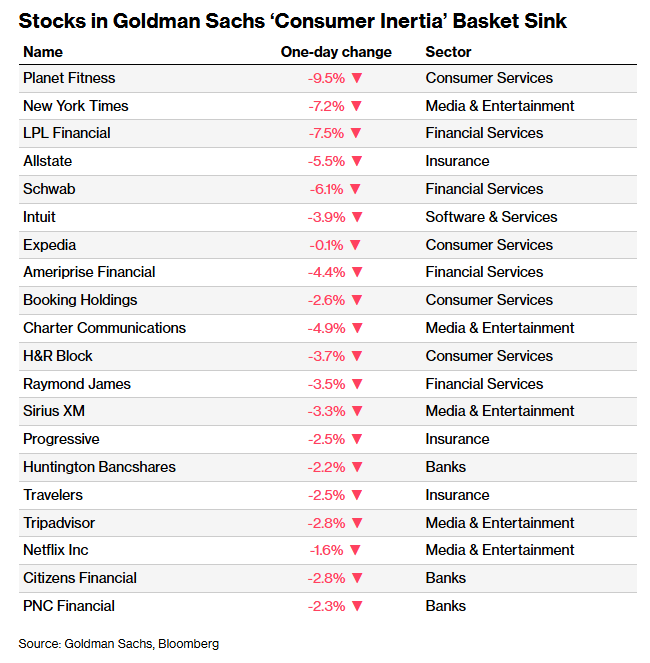
I’m wondering if that sell-off presents some opportunities. On top of spending a lot of time with Muse, I’ve talked to tons of my “normie” friends about it. Perhaps this is a small / early sample size, but my takeaway is that most people (including myself) who get access to Muse have an early productivity burst and then fade off hard. If that’s correct, then the market might be overfitting the early productivity burst and selling off the “inertia” names too hard and with too broad a brush.
Let me start by defining that “early productivity burst that fades off” statement. Nearly across the board when I talk to friends who have tried Muse (or similar consumer agents), our first conversation will be super excited about using it and all of the money they’ve been able to save…. but when I do a follow-up chat with them a few days later, they’ll mention how their Muse usage has fallen off a cliff.
Here’s my suspicion: the “use Muse to cancel unwanted subscriptions / price check your monthly charges” use case is so obvious and so easy to use (and results in “free” savings!) that basically every consumer is going to use it…. but consumer habits are really sticky. Saving money by asking Muse to check your subscriptions is a one-time, easy use case. Changing the way you interact with your phone / email / calendar to use Muse requires breaking the chains of habits, and that’s really difficult.
And, even if you’re willing to break the chains of habit, often you’ll find Muse isn’t quite ready for the task. Let me give an anecdote: I’m prepping for a Hyrox in a few weeks, and I wanted to eat really clean to peak for the race. So I asked Muse to put together a “clean eating” Instacart basket for me as well as reorder the staples that we get for my family to cover the next ~week of eating. Muse proceeded to put together a ~$1k grocery basket that had a borderline preposterous amount of food. It would have been enough food to feed a family of ~12 for a week, not a family of four (particularly with the four including a toddler and an infant!). Among other issues, I think it had enough chicken to cover ~15 meals, plus another 10 meals worth of steak, 8 meals worth of lamb, and then maybe 25 meals worth of different types of tuna for good measure. In reordering staples, it looked and saw that we had bought diapers in each of our last few orders…. so it included all of the different diapers that we had ordered over the past few months (i.e. size 1, size 2, and size 3 diapers). That’s great…. except our daughter is wearing size 4 now, so all of those diapers were useless (and who needs size 1, 2, and 3 at the same time anyway?).
That’s a small (and humorous) example of Muse messing up. And, if you’ve been working with AI agents for a while, you’re probably familiar with agents goofing up their first go-rounds until you can fine-tune them. Completely normal! But the market is starting to price the “inertia” names as if Muse is instantly going to dominate consumer usage, and these are the types of errors that consumers who are using agents for the first time see and think “I knew this AI was overblown; I’ll stick with what I’m currently doing and try it again in a year.”
So that would be my first area of pushback on the market on the “inertia” names: I’m starting to hear people talk about Muse’s near term impact on earnings, and for many of these businesses, I suspect the near term impact will be minimal. That’s not to say it will be minimal for all businesses; again, the early use cases seem to be cancelling a lot of subscription businesses that aren’t getting used; I suspect a lot of consumer media companies (Netflix, HBO, etc.) are going to be calling out elevated churn over the next few months!
Now, maybe you’d accuse me of not looking far enough out with that statement. Even if consumer adoption of Muse and other agents is slow and it doesn’t impact things in the super near term, the agents could and should have a massive impact on the terminal value of these companies. Yes, maybe Expedia’s earnings this quarter or even this year won’t be affected by agents, but now that we’ve seen what agents can do, isn’t the market right to start pricing in some chance of Expedia (or choose your “consumer inertia” company) being permanently impaired or, at minimum, having a much lower terminal value?
Perhaps!
But I’d ask you this: what’s really changed over the past month? It’s been obvious for a while that consumer agents were coming. Yes, Muse is a well designed product, but did anyone really think we wouldn’t have a well designed consumer agent in the next 3-5 years? Why did Muse getting released in September versus, say, December of this year or June 2027 change the terminal value of these businesses? Every Expedia / Booking / pick your consumer company out there should have been thinking about the consumer agent risk to their business months ago. One successful release that everyone should have been anticipating shouldn’t change any of that; a lot of the stuff that Muse does is stuff that the most advanced AI people have been doing on their own for over a year. There’s simply no reason this should be a surprise to investors or companies.
So I suspect that Muse usage will be a bit slower than the breathless forecasts I’m seeing (and, to point the finger at the mirror, I’ll admit I was probably guilty of making those breathless forecasts just a few days ago!), and I suspect that the market is shooting the “inertia losers” just a little too hard given this risk has been very visible / present for the past year.
But there’s one more area where I’d critique the market: I think it’s hitting the inertia losers with too broad a brush.
There are a lot of “inertia” businesses that are in trouble. Again, I hate to keep beating the same drum, but I think a lot of online subscriptions (TV streamers, newspapers, etc.) have a lot of customers who signed up a few years ago and don’t even realize they’re on auto-renew. Those businesses are in a lot of trouble.
But just because a business is a subscription business doesn’t mean it’s in trouble. For example, I suspect Netflix will have a little increase in churn, but Netflix is also the largest streamer out there. People who have Netflix generally watch a lot of Netflix, and unlike a lot of other streamers Netflix makes it really easy to cancel if you’re not watching. So I think the impact on Netflix will be much lower than, say, Peacock, where I suspect a lot of people signed up for the Olympics a few years ago and completely forgot they had a subscription. So I don’t think Muse leads to a broad-based increase in churn; I think Muse leads to huge churn from businesses that have a lot of subscriptions that consumers don’t value. It’s funny; for a long time Netflix used to make arguments around how engaged their consumers were and how much of a value their subscription was; that type of argument can seem quaint when an investor hears it for the first time (“that’s nice; why don’t you flex some pricing to beat the quarter”), but in the long run that “deliver more value than you charge” strategy is the exact type of strategy that wins out / proves robust to a changing landscape.
Businesses that have easy replacements and have made their money keeping consumers because they’re a hassle to cancel are prime targets for consumer agents. So I think something like Planet Fitness might have an uptick in churn. But that’s because Planet Fitness is a commodity business (all gyms are basically the same) where a lot of their “users” don’t actually use the product (in fact, a large part of Planet Fitness’s model is built on the assumption that many of their members are extremely low usage).
Contrast Planet Fitness to something like home internet; people use a lot of home internet. Yes, Muse might be able to find you savings by switching providers…. but broadband is generally a duopoly business (most people have, at best, two potential providers: a local fiber player and the local cable player); I’d guess that a duopoly can figure out how to keep strong pricing even with Muse trying to play them off each other. And to switch internet providers requires mailing equipment back to your provider, getting new equipment from your new provider, and sometimes having your whole house rewired. That’s all stuff that Muse can’t handle; are consumers going to be willing to make that time investment just because Muse found them a provider that will save them ten bucks a month?
I’d also note that many of the “inertia losers” have had pretty obvious inertia bear cases for a long time that haven’t played out. For example, banks are currently getting hit by Muse on the theory Muse will help customers cash sort. That’s a scary bear thesis for a bank investor; the whole reason the banking system works is because deposits are super low cost financing for banks. But it’s also not a new bear thesis; people were terrified of the cash sorting risk when SVB blew up in early 2023, and you can find similar fears of competition driving net interest margin compression every few years. For the most part, those fears have never played out. Perhaps Muse makes it so easy that this time is different, but “this time is different” is a bet I generally don’t like making.
I’ll wrap this article up here with one note: there is an old saying “strong views, weakly held.” AI is moving and evolving quickly, and I’m trying to evolve my own views in real time (again, just a few days ago I was way more bearish / in line with how the market is treating these!), so I’d say that my views are more along the lines of “medium strength views; weakly held.” It seems to me that the market is treating all of the inertia losers with a very wide brush, and both history and the evolving usage I’m seeing suggest that the brush might be just a bit too broad…. but I’m also willing to change my mind and be proven wrong as the products (and the usage of the products!) continue to evolve.
Regarding banks - it seems like ultimately it should benefit some banks, right? Like people are going to keep their money somewhere, so does it mean that they tend to move their cash to more efficient banks that can afford to pay higher rates?