
My post last week on “The rise (and downsides) of AI agents in investing” generated a lot of feedback and interesting discussions…. but, humorously, the feedback and discussions largely weren’t on what I thought they would be! One particular line seemed to grab a lot of people’s attention. It was:
You have to wonder if every consumer subscription business is about to see a spike in churn as consumers get comfortable having an AI agent monitor their usage and cancel subscriptions the moment they don’t need them, and it’s easy to see OTAs (like Booking and Expedia) quickly finding themselves getting replaced by agents.
That line struck a chord with a ton of people because there’s some belief that consumer AI agents are about to set off a “SaaSpocalypse 2.0” in the consumer space.
Why?
Well, the major use case for consumer AI agents right now appears to be using them to save money. Just go look at Meta’s AI Chief’s Twitter page and you’ll quickly see what I’m talking about; he loves to retweet how people are using Muse and most of the retweets are something like “Muse saved me $700 in insurance” or “Muse saved me thousands on returns and phone bills” or even “Muse got me tons of free food for my birthday”…. and he really does celebrate the savings.
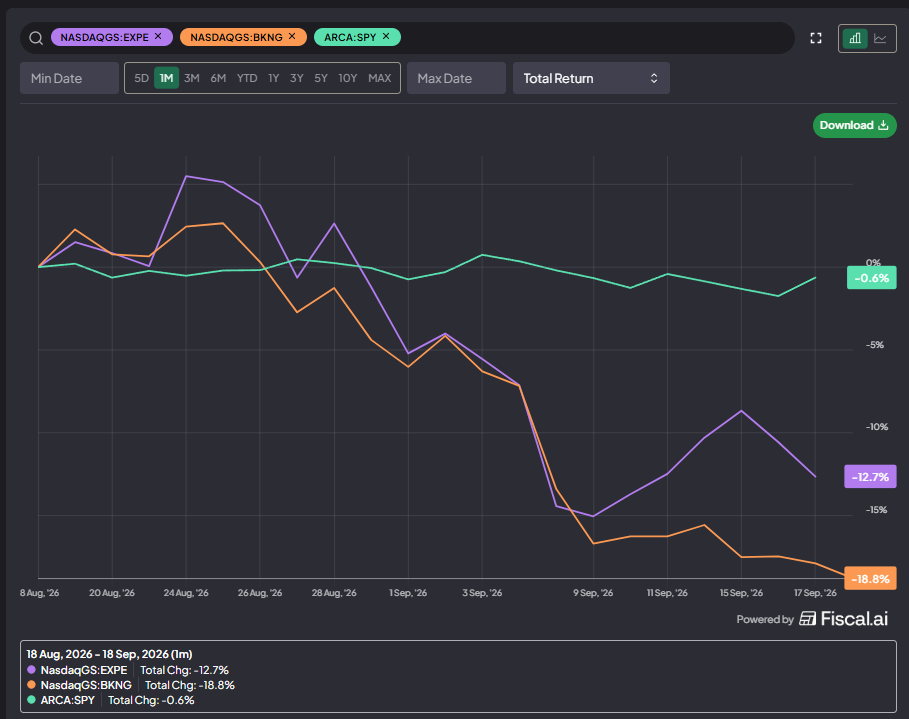
So most of the inbounds I got were on the lines of “what’s a short if AI agents really take off.” There are some obvious answers; the most obvious (and the one I mentioned in last week’s article!) is probably OTAs like EXPE and BKNG. Why? Well, if you can just go into Muse and say “I want to go to Paris for three days; plan a trip for me with a hotel that costs less than $300 a night and a nonstop flight”, then what’s the point of an OTA business? And the market seems to be expressing some worry; EXPE and BKNG are down a lot over the past month and the drops started right when Instinct and Muse took off.
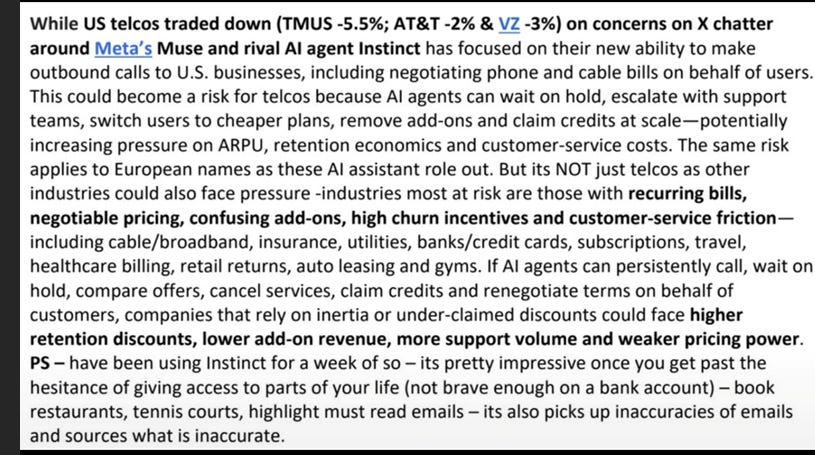
The short ideas from the rise of consumer AI agents are basically endless; basically, you can just go through the list of things people are saving money on and ask “is this company / category a short?” The most popular thing people are saving money on appears to be internet or wireless bills, and that’s also the thing I’ve probably gotten the most “is this a short” inbounds on, so directionally everyone seems to be in the same place… though that’s probably starting to filter into the market given the sellside notes I’m seeing. For example:
But I wonder if people are underestimating the impacts of consumer AI agents. If these really take off, there could be massive second order implications. I’m not saying any of these are guaranteed, but today I want to get a little galaxy brained and discuss three potential big trades / implications from the rise of consumer AI agents.
The first trade is actually simple: we see another leg up in the AI build out story. The AI story really took off early this year when coding agents started going parabolic; if we really saw consumer agents take off, we could see that demand leg take another step up (particularly if consumer agents taking off requires businesses to invest in their own agents to meet or handle that demand). So if you really believe everyone is about to be outsourcing huge pieces of their life to an AI agent like Muse that they interact with for huge swaths of the day, I’d guess that the AI winners from Q1/Q2 see another leg higher. Think memory, power, semis, etc.
Let’s go to the more out there trades. The second trade is probably the most interesting one to think about (at least to me!): if AI agents are going to handle huge swaths of consumers’ spend, what happens to consumer brands? And what impact does that have on advertising budget?
An example might show this best. Right now, if I’m in the market for a new pair of running shoes, I probably just go to Nike’s website, pick out the last pair of shoes I bought from them, and reorder it. If the shoe is discontinued, I’ll pick the most similar style. Maybe I’ll go to ChatGPT and tell it a bit about myself and ask it to recommend shoes, but I’ll probably discount those recommendations and lean towards the brands I like. And, while I’m buying the shoes, I might throw in a pack of new running socks or something.
Why do I buy Nike shoes? In part because I’ve always bought them, and probably in part because years of marketing from Nike have trained me that athletes wear Nikes.
Now consider a world with agents. If I tell it “I wear a size 12 shoe, have a flat foot and some Achilles tendonitis, and run ~15 miles/week; find me a pair of shoes that works for me”, does it just go out and order the shoes with no regard for brand? Does it let me nudge it to Nike shoes but say “hey, I could save you $5 and get you socks just as good by passing on the Nike socks and buying this brand of socks”?
If Muse (or an AI agent) is doing the buying, do brands have a lot less pricing power and a lot less customer loyalty? And, if that’s the case, what happens to the advertising industry? Do all of those brand advertisements you see during football games suddenly become wasted inventory? What about Google AdWords; if Muse is handling the majority of your search decisions, has the Google monopoly finally broken?
I don’t know the answers to any of those…. but the more you use AI agents, the more you trust them and the less you use other forms of the internet. Brands advertise to you because they trust that, when you make decisions, the advertising will nudge you toward those brands; if the AI agent is the ultimate decision maker then all of a sudden all of those brand advertising dollars look like wasted spend.
Alright, last out there idea, and it kind of builds on the former’s “deflationary pricing” angle. AI agents let you price shop very easily; again, the internet is filled with examples of people saving hundreds of dollars quickly comparing insurance / internet / wireless / etc, and I’m seeing lots of signs of people using them to save money in other places. AI agents also let you replace a lot of skilled workers; as just one example, I’ve recently experimented with having AI edit the podcast instead of a consultant. I know of dozens of stories of people making a similar switch / savings with AI. If the core use case for AI as it relates to consumers is saving money, does AI have a deflationary impact on the consumer economy at some point in the near future? That would be quite the economic windfall, and given interest rates have been rising / the Fed appears to have just kicked off a hike cycle, it would be largely out of consensus / a pretty out there trade.
Anyway, I’m not saying I have massive confidence in any of those three calls / trades….. doing that involves having a crystal ball with both how AI and consumer behavior plays out, and I have neither. But Muse does appear to be gaining traction quickly, and it’s really interesting to watch, in real time, something that has the potential to shift the economy and the market in ways similar to what AI did in late Q1/early Q2 this year. I think it’d be silly to not be at least thinking about it!
PS- A reminder that I’ve spoken to the team at AlphaSense about my AI agent usage quite a bit, which is one of the reasons they chose it as a topic for my upcoming (free!) webinar with them. Given its timeliness / relevance, I’m obviously very excited about it; you can sign up for the webinar here (it will be live on September 22).
Like SaaSpocalpse, I think this narrative really overestimates how many people actually use AI. Habits take time to build, and the vast majority of the population just doesn't use AI the way power users think. Or have formed the habits to ask AI to help them save cash. Even if it does happen, it's a super long-tailed thing that isn't going to manifest anytime soon.