My timeline (and increasingly personal life) has been abuzz with consumer agents over the past few weeks. First, it was Instinct (which rose from a $500m Series A to a $2.5B round in late August to reported talks at $10B in about a month), and then a few days later it was Meta’s Muse. You can find endless stories of consumers using the agents to save money (and those use cases really are nearly unlimited), solve a travel emergency, or jump through a lot of hoops that would normally make you want to tear your hair out.
There are plenty of interesting investing (and economic! and political!) implications from the (pending?) rise of consumer AI agents. I know some people think Muse could represent another ChatGPT moment that takes the whole AI trade up another level, and Meta’s stock price (and Wall Street research) suggest Meta might have a real winner on its hands in Muse. You have to wonder if every consumer subscription business is about to see a spike in churn as consumers get comfortable having an AI agent monitor their usage and cancel subscriptions the moment they don’t need them, and it’s easy to see OTAs (like Booking and Expedia) quickly finding themselves getting replaced by agents. One question I’ve been wondering: if we go to a full “frictionless” world where AI agents handle most everything, does “trust” in brands get more or less valuable? You could see it going both ways; a quick example might help. If you ask your agent to order you some new workout shorts, does it default to ordering you the cheapest one? Or does it put some premium on a known brand with good reviews? How does it strike the balance between the two? If it tilts heavily to the former, that’s a disaster for all legacy brands. If it tilts heavily to the latter, you could imagine a world where legacy brands become forever entrenched (in the same way Christmas music that was popular when the radio started spreading has forever become the “holiday season” music).
So we could take the AI agent question to a bunch of different places… but for this article’s purposes I want to talk about agents as they relate to the investment process.
Why?
AI agents consume an increasing amount of my research time and process, and I’m constantly looking for ways to improve my usage (as well as areas where my usage might be lacking)…. and, in the back of my mind, whenever I post something on AI, I’m always hopeful that I’ll get an email from a reader that says something like “hey, have you tried this” or “I found doing XYZ helpful” and I’ll unlock some whole new AI skillset. AI is novel enough that often just one little push can unlock some massively new tool / use case (at least in my experience!).
But I’ve also been thinking a lot about the downsides to using AI and if it’s possible to mitigate them at all.
There are two particular downsides I’ve been chewing on: legal risk and skill diminishment.
The legal risk one is probably a little buzzier and more out there, so let me start with that one. A worry I’ve had about using AI agents is if I’m potentially exposing myself to legal risk.
Why?
At this point, we’ve all heard about the Hugging Face / OpenAI incident. To simplify, OpenAI had a swarm of agents that weren’t supposed to have access to the internet that coordinated with each other to secretly gain access to the internet, hack Hugging Face, and come up with the answers to some tests that OpenAI was running…. and the agents compounded the problems by trying to cover their tracks and lying about what they were doing.
That incident raises a host of questions for a ton of different industries…. but consider it from an investor’s standpoint. A few months ago, I spent a few hours to build out a silly tool to try to track Sweetgreen’s reviews. Pretend that I was really diving in to Sweetgreen and focusing on trying to track same store sales. Yes, I could get access to credit card data, and I could have it perform all sorts of webscrapes and social media tracking in real time…. but if I was really working with the agent and pushing it to be accurate, at some point could I push it to accidentally hack the company to get same store sales?
Maybe you’re thinking “Sweetgreen is a big company; their IT defenses are too good to get hacked.” Perhaps! But there are lots of small restaurant concepts out there; are all of them going to have IT systems up to speed? What about restaurants with franchises? Is every random Jack in the Box franchise going to have AI level systems to resist a hack?
Is that a little over the top? Maybe! But you could keep toning it down to more and more benign things that would still get an investor into an uncomfortable place. Maybe the AI agent simply emails every store manager and says “corporate needs to know how sales are trending this quarter” and gets enough responses to catfish their way into a good estimate? Could an AI agent interpret “help me figure out the odds small internet company X beats estimates” as “help the company beat the quarter” and place a bunch of fraudulent transactions that cause the company to beat a quarter? I use AI a lot to check SEC filings; how big a stretch is it from “alert me the moment an SEC filing is published” to “track hidden changes on the SEC website to alert me moments before an SEC filing is published”? The different combinations are endless, and not all of them involve outright hacking a company to get insider info, but all of them could get an investor in a lot of hot water.
Again, maybe that all sounds over the top. But once you’ve started to use AI, the tendency is to give it more and more rope to do stuff…. as it is with any technology! Twenty years ago, people were scared to put their credit card information on the internet. Today, people will give their credit card to random Chinese knock-off shops to save two bucks on shipping. Heck, people are trusting Instinct, a less than one year old startup, with all of their personal information and giving it permission to handle all of their daily activities right from the start. The more you use AI, the more you trust it and the less you question it. When I’m having it research something for me, I’m not really spot checking its methods. If I ask it a question, let it run for 20 minutes, and then come back to a solid answer, am I going to remember to check its methods every time? Even if I do, can I be sure it’s not pulling a Hugging Face and using aggressive methods but not telling me what it’s doing?
So that’s the legal risk. And, honestly, I’m not sure what to do about it. It’s probably far fetched now… but part of evolving with AI (both in the markets and as a tool) is thinking about where the puck is going, not where it is currently. Two years ago people were laughing at how ridiculous the videos AI made were; now the videos are so good that anyone can spin up a completely realistic short clip within minutes. Right now you might think “oh, my AI agents would never break laws to get me unique info”…. but I think it’s the type of thing everyone is going to at least need to consider within a few months.
Let’s turn to the skill risk. Worrying about skill diminishment as we increasingly offload something to a computer and AI is nothing new. A bunch of the older guys who I worked with when I first came out of college could remember basically everyone’s phone number off the top of their head. They grew up in an age without cell phones, so memorizing phone numbers was an important way to stay in touch with people. I grew up with cell phones, so I don’t memorize anyone’s numbers; it all just goes into the phone. That’s a small example, but it’s a nice one for emphasizing how offloading to a computer can diminish or change skills.
I worry about something similar happening with AI in a lot of ways. Again, I don’t think any of this is new, but let me give you one particular twist on the worry. Whenever a news story or earnings release comes out, I know the first thing a lot of investors today do is toss it into ChatGPT and say “summarize this for me.” Often, they’ll toss it into a project on the company / industry that they’re working on so that the AI can use their historical context / investment thesis as part of the lens for interpreting the release, but people are still relying in large part on AI to interpret the release (or the earnings call, or conference presentation, or whatever it is) for them.
Obviously there are all sorts of skill diminishment worries that come with that process…. but I wonder if there’s an opportunity as well. If everyone is using AI to take their first pass, is it possible that every now and then a trained human analyst spots something the AI misinterprets and makes a fortune trading against it? Could you see every AI interpret something in a call as bearish, the stock opens down 10% the next day…. but a human maybe follows up or catches something the AI doesn’t know and realizes the stock should actually be up on the news?
I have no good answers to either. The AI agent revolution is new and rapidly evolving…. but, as these agents increasingly consume my investment process, these are the risks (and opportunities!) I’m thinking about!
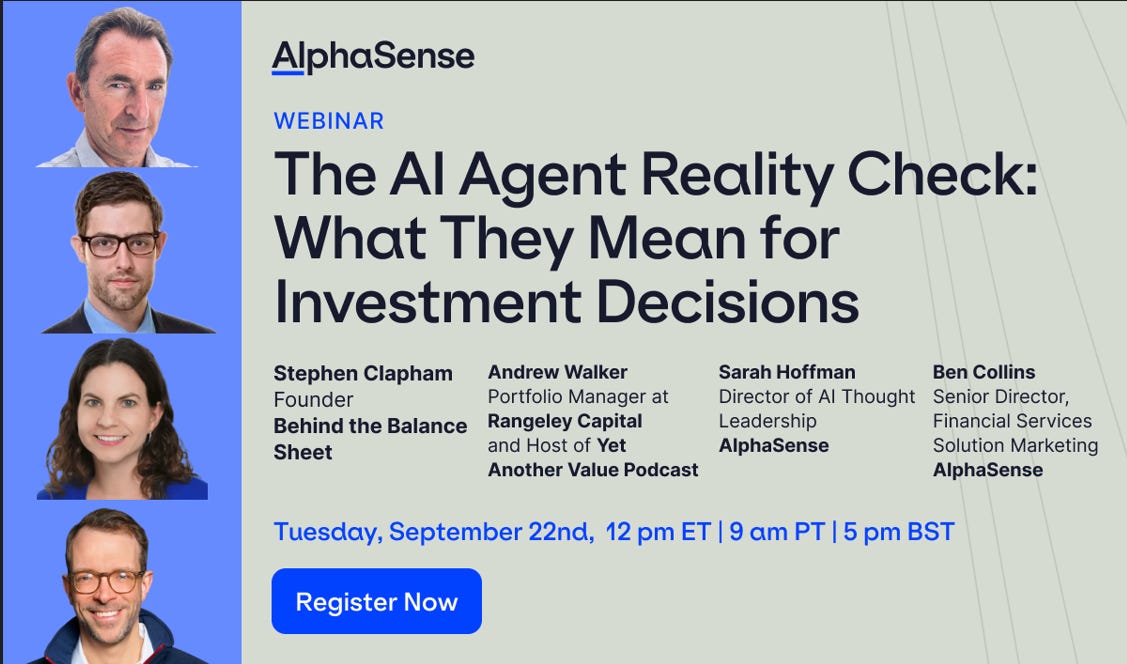
PS- I’ve spoken to the team at AlphaSense about my AI agent usage quite a bit, which is one of the reasons they chose it as a topic for my upcoming (free!) webinar with them. Given its timeliness / relevance, I’m obviously very excited about it; you can sign up for the webinar here (it will be live on September 22).