
The sports world is obsessed with the implosion of Mark Walter’s sports empire right now. The NYT is averaging about an article a day on the story, and it’s the headline story on basically all of the basketball and sports podcasts I listen to (though, admittedly, it’s a kind of dead period for sports content right now, so they may also just be trying to fill up the airwaves).
The Walter story is pretty wild. At a high level, the allegations seem to be that he used undisclosed related party loans from his controlled life insurance companies in order to fuel his sports empire. When insurance regulators realized what happened, he needed to immediately begin fire-selling his empire in order to pay back the loans… though, having seen the prices and market panics that a true fire sale generates, I will be honest that I struggle to see selling the Lakers for $12.5B less than 18 months after buying them for $10B qualifying as a fire sale! A real fire sale normally looks like what happened to Situational Awareness in July: short sellers get word you’re in trouble, all of your marks go way against you as everyone bets that you’ll be forced to unwind, the bets against you push prices even lower and become something of a self-fulfilling prophecy, and you’re forced to sell to Citadel at a massive discount (I wrote about Situational Awareness twice this summer; see those posts for more).
Anyway, the whole story is pretty insane, but there is one piece that drives me a little batty. Every time I hear a media personality talk about the story, they’ll express some populist outrage that Walter could buy the Lakers for $10B and flip them for $12.5B roughly a year later, and they’ll talk about it like it was some genius trade.
Let me be perfectly clear: Walter’s Lakers investment was not some genius trade. In fact, it was not even a particularly good trade. My dog could have beaten this trade with an index fund.
I get it: ~$2.5B of profit is a big number, and it seems crazy someone could buy a marquee sports franchise and then immediately flip it for billions in profit. And a 25% headline return in ~18 months is, in the absolute, pretty solid!!!
But the complaints I hear seem to be along the lines of “these rich people get access to all of these great sports investments that we don’t.” I’ve spent a lot of time researching investments in sports teams; there’s more than a kernel of truth to that complaint. Sports teams get unbelievable tax breaks, their artificial scarcity creates enormous benefits in a world of rising wealth, and I think the prestige that comes with owning and running a sports team has been perennially underpriced in the private markets.
All of that is true…. but Walter flipping the Lakers for $12.5B has nothing to do with any of that, and I think pointing to the flip as some great investment actually does the arguments around sports investing a disservice.
The fact is that Walter’s investment in the Lakers was, at best, an average investment (and that’s if you put aside the possible jail time it could result in if the allegations on the related party dealings are true!).
Let’s start with the headlines: the Lakers valuation increased from $10B to $12.5B under Walter’s brief ownership. That’s a 25% increase; again, not bad in the absolute….. but equities have been on an absolute tear over the past year and a half. No matter what index you use, Walter’s investment has actually underperformed:
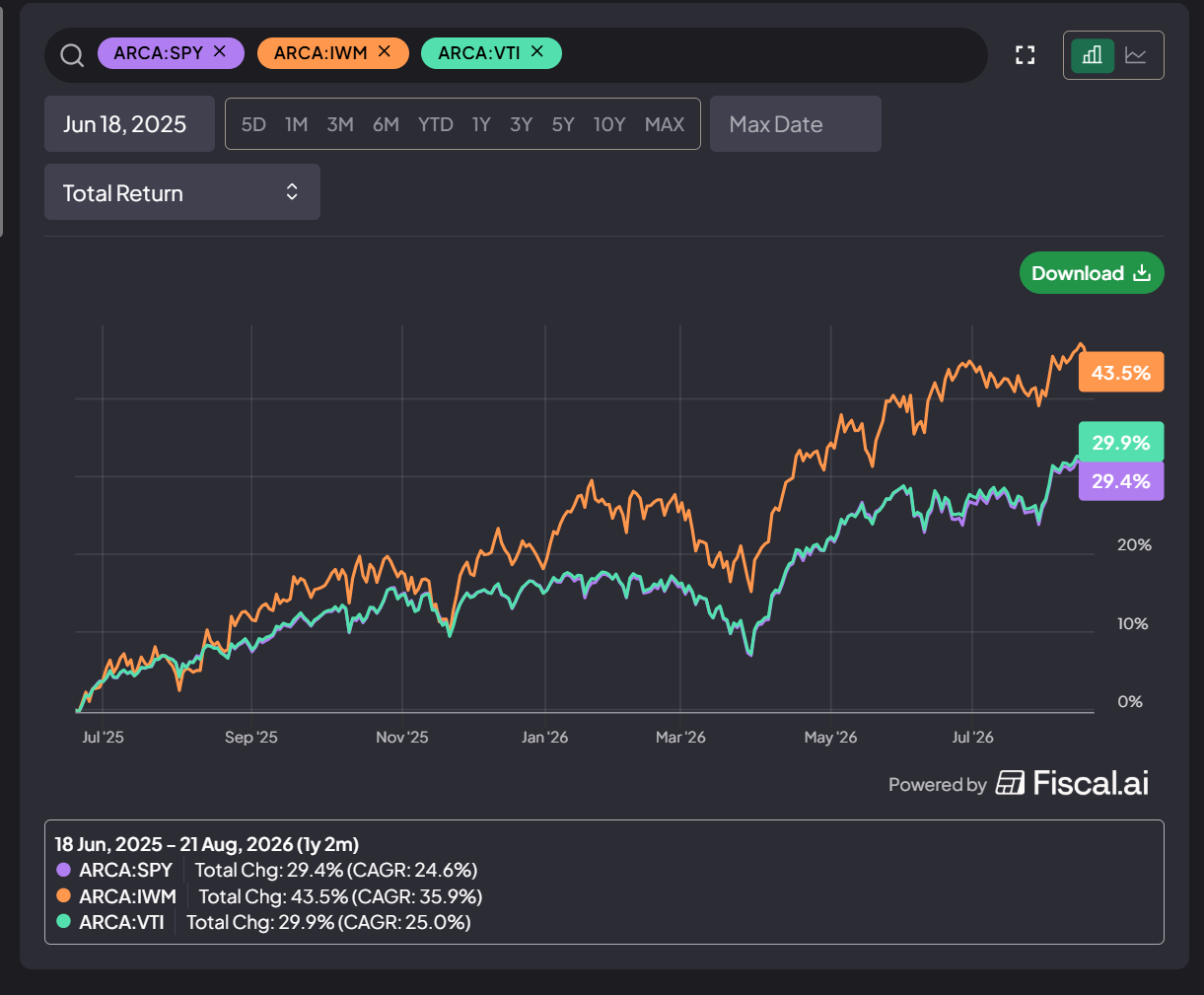
To put numbers on it: the Lakers are up 25% on the flip, and every index in that chart is up more than that, with the broad market up ~30% over the same stretch.
Now, I can imagine all sorts of pushback to that comparison; at a high level, I’m comparing a privately owned sports team to general public equities…. but I’d argue that those arguments actually further emphasize that the Lakers were a bad investment for Walter! In general, given illiquidity, you’d expect private assets to outperform public equities1. I’d also argue that sports teams are, to some extent, a levered bet on global wealth, so if equity markets are up ~30%, I’d expect sports teams to do better than that. For the Lakers (a trophy franchise in a buzzy sport) to see their price underperform a booming equity market suggests the Lakers trade wasn’t exactly great for Walter (and, again, that’s ignoring the possible jail time).
And none of that considers the complexity and transaction costs of buying a sports team. Assuming you had the money, you could buy $10B of broad-based ETFs in a day with basically no transaction fees, no high priced advisors, and just generally no headaches. In contrast, closing a $10B private transaction like buying the Lakers would involve months of work and likely hundreds of millions of transaction costs once you factor in all of the financial advisors, lawyers, etc. that come along with it. Similarly, you could sell $12.5B of broad-based ETFs in a day, but selling the Lakers at a $12.5B mark would incur hundreds of millions more in lawyer / advisor / transaction costs, to say nothing of your own personal time value from spending weeks or months of your life on the transaction.
Again, I’m not saying it’s not crazy that Walter could allegedly run a scheme like this, get caught, and still make billions in a fire sale of those assets. But I am saying that I hear a lot of people complaining about him making a lot of money like he had access to some secret investment, and the simple fact is that anyone (you, me, a baby, my dog) could have massively outperformed Walter’s Lakers investment with far less headache by buying an equity index and then going about and living life.
People always ignore the value of liquidity…. until they really need it! If Walter really had to sell assets because of the insurance probe, do you think he’d rather own the Lakers and need to negotiate and wait for months for the sale to close, or $10B+ of a liquid ETF he could sell inside of a day?
Asking whether a trophy asset was really a winner is the value tell — returns hide in the cash-on-cash, not the highlight reel.
Disagree. Market you don't know if it goes up or down and also the market is leveraged to one big trade. With Lakers you have more certainty it goes up she to scarcity and brand value so I argue the risk adjusted returns are better. Also his leveraged return will be much higher, especially if somehow he skates by on the inter party loans which I am sure one donation to the Trump family can cure.