
The internet (at least my little corner of it) is abuzz with the (seeming) implosion of Situational Awareness.
For those unfamiliar, Situational Awareness is (was?) a buzzy hedge fund that called the AI trade basically perfectly last summer. They rode that call to unbelievable returns; I think the reporting is they were up something like 500% in the first half of the year (and I don’t say 500% as a loose number to say they were up a lot; I believe the reporting is they were up literally almost 500%). However, as the AI and momentum trade have suffered a rough July, Situational Awareness appears to have been caught in the crosshairs. There were online rumors1 that they were down ~30% YTD, which would imply they drew down 85-90% from the peak (and in a very short time frame).
There’s plenty of reporting2 to do on the implosion of the fund, and there will be plenty of schadenfreude from people celebrating Situational Awareness’s (seeming?) demise…. and I’ll admit it’s hard not to have a little schadenfreude at someone in their mid-20s with no investing experience starting a fund and generating legendary returns3 and then imploding because they couldn’t manage risk.
But I’ll leave the reporting and schadenfreude to someone else. I wanted to talk about two intertwined angles to the Situational blowup that I can’t get out of my head: the opportunity (or lack thereof) angle, and the bubble / capital allocation angle.
Let’s start with the opportunity angle. As investors, there is nothing better than a forced seller for a very simple reason that is literally in the name: forced sellers are forced to sell at basically any price to someone who can give them liquidity. However, finding forced sellers is devilishly hard; sellers know that they’ll get destroyed if people realize they’re forced to sell, so they don’t exactly go around emailing everyone saying “we desperately need liquidity; we’ll take whatever you bid but you have to bid right now.”
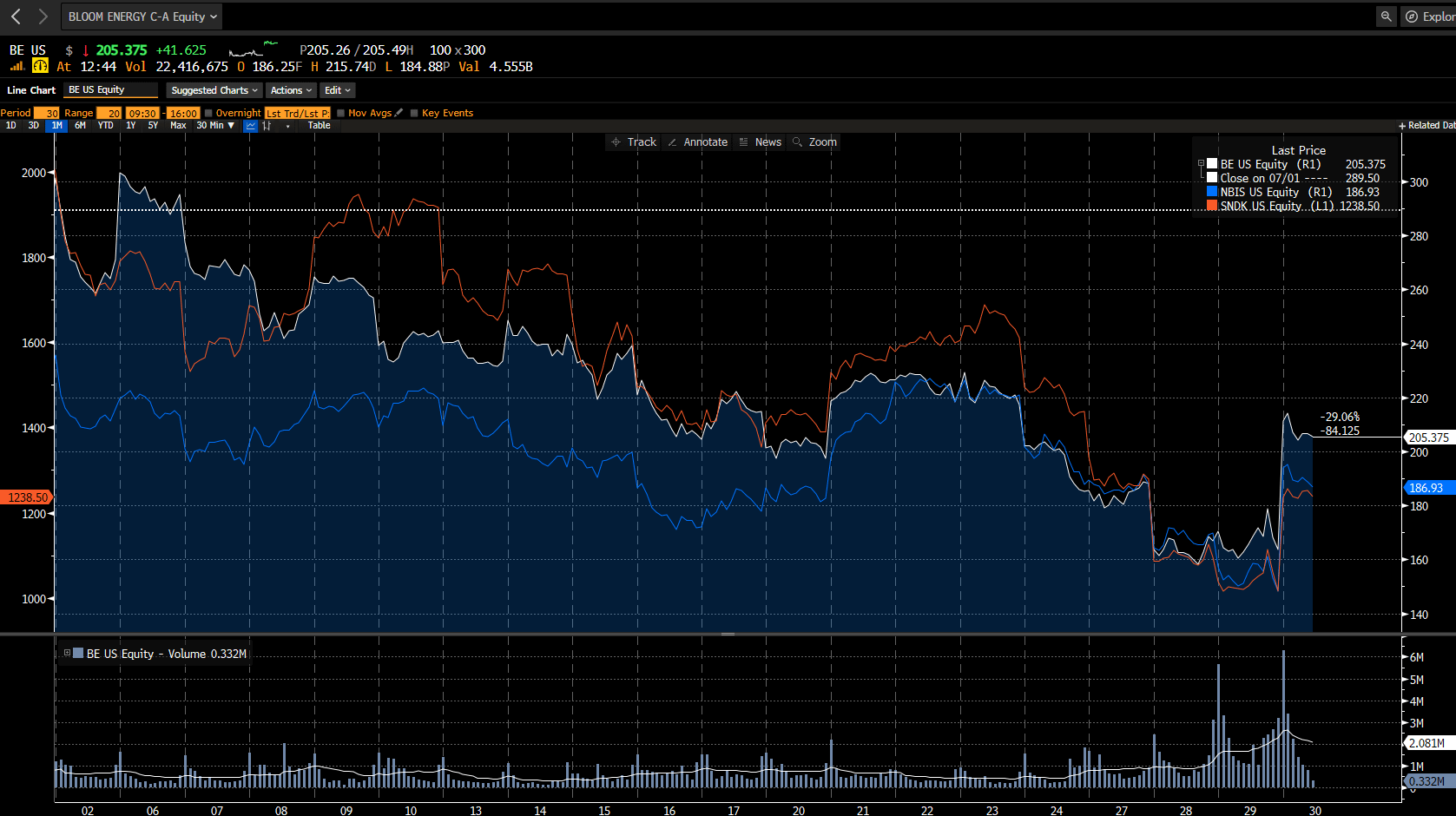
Pretty much the only time you know there’s a forced seller on the other end is when it’s a big fund that’s getting margin called somewhat publicly. Unfortunately for us, Situational Awareness seems to have done a good job of keeping their liquidity problems private; if you look at some of their chunkier positions (SNDK, BE, NBIS), they were moving in lockstep over the past few days and had huge bounces today on the unwind news, so while the prices are down a little it’s hard to point to a massive dislocation.
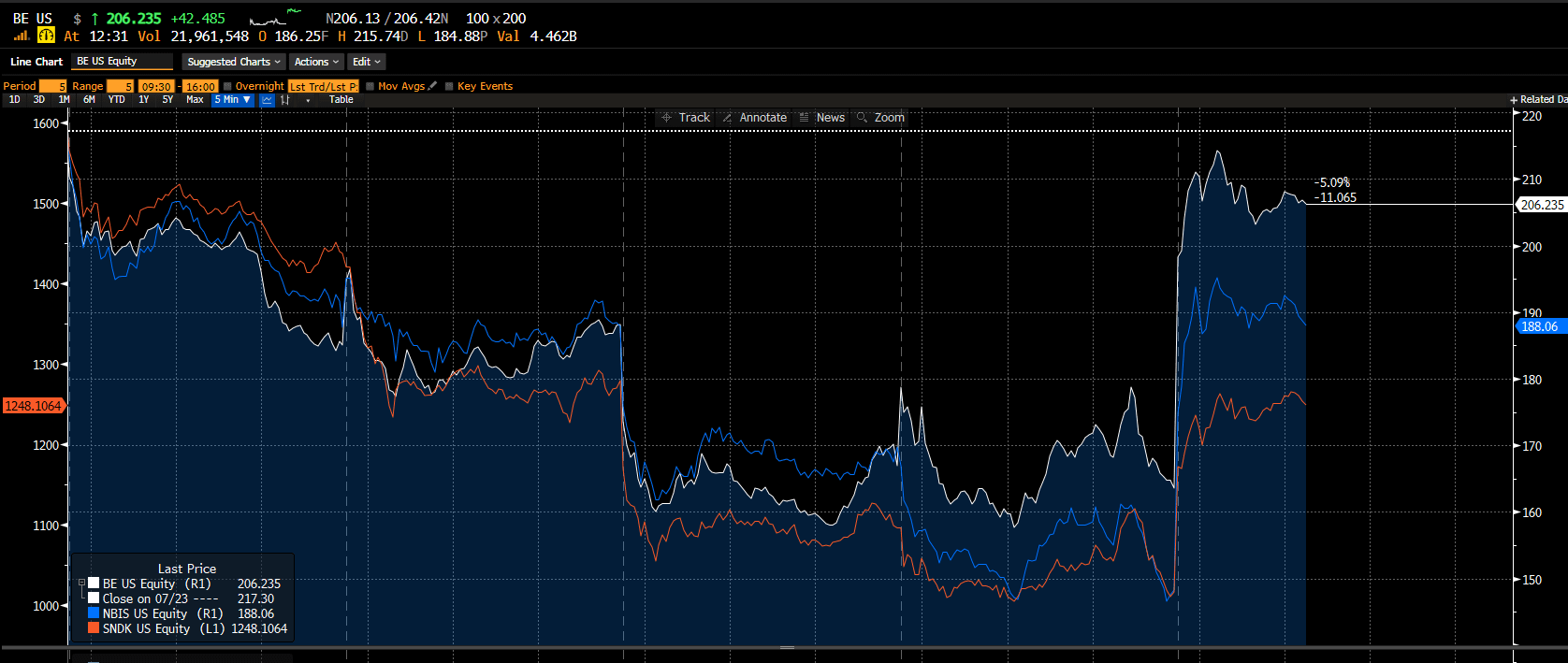
That said, while the price dislocation in the past few days was reasonably contained given the level of blowup, a lot of these are still down massively over the past month or two. Even with today’s big pop, most of these are down 30-40% over the past month:
And it’s not just Situational driving that big sell off; a Goldman note apparently estimated there were 1.2m margin calls in South Korea over the past month, meaning a not insignificant percentage of the adult population got hit with a margin call (it works out to ~3% of the adult population, but if you assume that the average person trading on margin is overwhelmingly likely to be a male in their 20s or 30s, I think there’s a possibility that >10% of South Koreans in the target demographic got hit with margin calls).
So you’ve got a whole sector getting swamped by margin calls and forced sales. The trader in me sees that and thinks “o man, I’ve got to buy and be on the other side of that!” because there will be a big snap back once the margin calls are finished.
Maybe! But here’s where I think some history is interesting. What you have in Situational + the Korean margin calls is a giant sector unwind leading to liquidations. These types of setups are pretty rare; the last one of these I can remember was when Archegos blew up and took down the media space and some Chinese internet stocks with them.
If you had asked me on the heels of the Archegos implosion, I would have guessed that every one of the stocks Archegos had been forced out of was an opportunity. While Archegos was a little smaller than Situational is today, Archegos was much more concentrated in much smaller stocks. So Situational owned like 2-3% of stocks like NBIS and BE, while Archegos owned 10%+ of stocks like WBD and PSKY (then ViacomCBS and Discovery)…. and often more ownership on an effective float basis given large controlling shareholders! Anytime you have a 10%+ shareholder getting blown out of a stock, I’d guess there’s opportunity!
And I would have guessed wrong! Below is a chart of the majority of Archegos’s holdings when it blew up; you can see that not only did all of them fall precipitously when Archegos was liquidated in early 2021…. but they all kept falling in the weeks and months and even years after. Despite a strongly rising market, basically every one of those stocks is well below the price Archegos got when it was margin called.
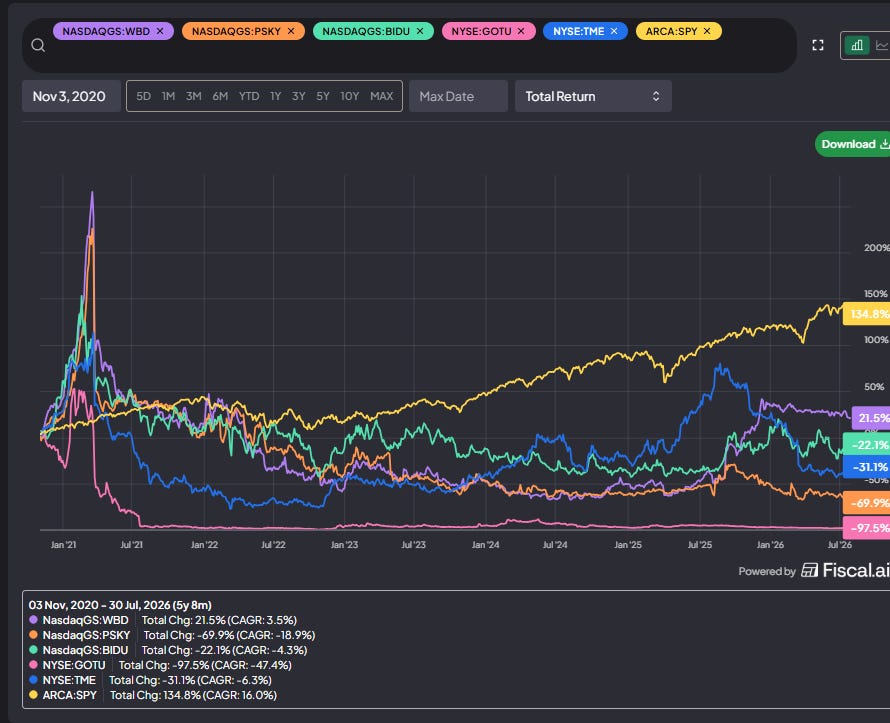
That’s strange, no? If you had told me that there was a stock with a big forced seller, I would have guessed that the company’s stock was crazy weak leading into the big sale, but then rebounded as time passed and supply / demand got more equal. I’d also guess that a stock with forced selling would outperform the market from the forced selling driven bottom. Archegos is very different; you have several different companies in different industries that are all underperforming even after a massive dislocation event!
That brings me to the second point: bubbles and capital allocation. Markets are designed to send pricing signals. Prices go up, rational actors respond to incentives and create more of that thing, and thus demand equals supply. When oil prices go up, oil stocks go up, oil companies can issue stock to go look for more oil, and eventually the world gets more oil.
Bubbles represent a misallocation of capital. The market is super hot for some sector or theme, it sends a pricing signal to fund lots of that thing…. and then it turns out that we overbuild whatever that pricing signal was pointing at. A great example of this is the digital asset treasury (DAT) trade from last year: the market was pricing any and every DAT at a premium to NAV, so tons of small companies pivoted to become DAT companies. That turned out to be a horrific allocation of capital and now all the DATs trade at a discount to NAV (with one exception!).
Generally, bubbles happen because of some mania…. but what happens if a sector wide bubble is caused by one fund levering up and doubling down on a specific bet?
I am not saying that’s what happened with Situational…. but I’m also not not saying that!
Go back to Archegos a few years ago. With the benefit of hindsight, it’s clear that they squeezed the stock prices of the companies they owned…. but it was not clear in real time. You can go look at what they were saying at the time; Viacom was talking about the stock run up just being “The market recognizing our potential as a global streaming powerhouse.” Viacom used that stock run up as a signal and raised ~$3b to invest even more heavily into streaming.
Now consider Situational Awareness. Almost every company they were invested in over the past few months saw their stock prices scream higher. At the time, we thought the price movement reflected the endless demand and bottlenecks from the AI buildout, and to some extent it probably was/is! But some of that squeeze was almost certainly Situational doubling down (plus everyone rushing to front run or clone Situational’s book).
Many of Situational’s investments raised a lot of capital over the past few months. SHAZ raised $1.6b in June. NBIS raised $4b in March. And even if they weren’t raising equity (or convert) capital on the open market, many of them were raising project financing that was in part supported by their stock price (or perhaps supported by the stock price and equity financing of the customers they were building the project for!).
If you go read the earnings calls for any of the hyperscalers, they’ll talk about how their massive investments in AI are backstopped not just by the ROI they’re seeing on their internal projects but also the massive demand / offers they have from third parties to buy their compute and power… and I can’t help but wonder if a lot of that demand came from stock prices that were, in some part, inflated by Situational Awareness.
I’m not saying AI is a bubble, or any of these gains aren’t real…. but it is kind of funny to think that there’s a world where a few years from now people look back and say “damn, that tiny little hedge fund managed to inflate an entire AI bubble / cause hyperscalers to commit to literally trillions in investments that there was no end demand for.”
PS- a lot of people have suggested to me that LTCM (of When Genius Failed) has parallels here. There are certainly some similarities (smartest guys in the room blow up with too much leverage), but LTCM was much more a macro fund that was really levered up on quant trades. It did almost bring down some banks given its leverage, but I don’t think it had huge impacts on specific stocks or sectors. In contrast, Archegos and Situational both really helped companies / sectors squeeze, but they didn’t really represent contagion risk to the overall economy….. so I think they fit together much better.
And online rumors are, of course, always 100% accurate!
As I was writing, Matt Levine published a nice overview / background / explainer.
In investing, you’re approaching GOAT territory if you do 20% annualized for 10 years. That’s ~500% returns; Situational Awareness did that in roughly six months to start the year!
I can't help myself: Korean investors who thought they had won facing margin calls.