
On the heels of losing a bidding war for TWO, in late March UWMC published a fabulous press release that called TWO a “melting ice cube.” I said at the time “that press release definitely does not make me think UWMC’s a bunch of whiny losers who I’d never want to invest with.”
Things have only gotten funnier since then, as UWMC followed up that press release by raising their bid for TWO and thus restarting the bidding war for an asset they had just called a melting ice cube. UWMC eventually lost that bidding war too…. and now they are blaming the busted deal for a ~$600m hedging loss they took in Q2, and that massive hedging loss was partly responsible for UWMC needing to raise some very expensive capital. The only problem with that explanation is the TWO deal had died in March (UWMC had the break fee wired to them on March 31)…. so UWMC spent all of Q2 hedging an asset they were no longer under contract for.
I’ll get to how strange that is in a minute, but let me back up and give a little background (in case you didn’t read my first mention of UWMC / TWO back in March) as well as provide an update on some of the crazy happenings since then that have led to this whole hedging fiasco.
The backstory
I’m a big, big fan of bidding wars. Writing that almost feels trite; what investor isn’t a fan of people competing to pay top dollar for a company they own?
So I’m not exactly breaking new ground saying “I love bidding wars”…. but I do. So much so that I wrote a mea culpa for missing the Metsera bidding war late last year.
Earlier this year, there was another bidding war that almost led to me writing another mea culpa. This one was between UWMC and CrossCountry for TWO. TWO had originally agreed to be acquired for all stock by UWMC back in December. However, UWMC’s stock was hammered after the deal was announced, falling >30% between mid-December and late March:
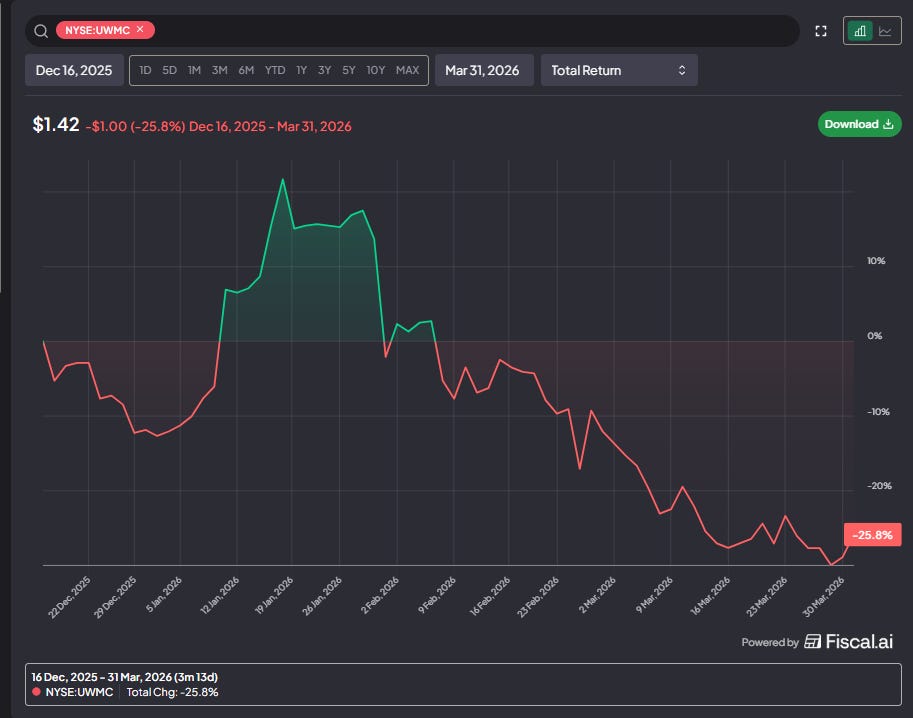
Let me pause here: one of my favorite event setups is when a company with a lot of strategic value agrees to sell themselves for stock and then the buyer’s stock collapses. Why do I like that setup? Because it creates an easy opportunity for someone else to step in with cash. A somewhat extreme example might show this nicely: pretend you and I are bidding on a company. I bid $90/share all cash and you ultimately win with a bid of $100/share all stock. If your stock falls by 90% in the next month, suddenly your $100/share bid is worth $10. Now, maybe your stock is down because the industry is imploding and the target company isn’t worth close to the original bid…. but maybe your stock is down for other reasons, and I have an opportunity to lob in an all cash bid at a massive discount to my original bid but a huge premium to the current price and make a fortune for myself (and save a ton of money versus my original deal!).
If you read TWO’s proxy, you could see something similar could play out: multiple companies bid on TWO, including one company who offered 1.15x TWO’s book value at closing in all cash. TWO ultimately chose to go with UWMC’s offer, which valued TWO around 1.15x their tangible book value and offered more closing certainty than other offers. However, even a definitive deal did not stop TWO’s strategic suitors, as the proxy reveals company C1 called TWO up after the UWMC merger had been announced to see if they could hash out a deal.
So I was thinking about writing a “mea culpa” because TWO filed that proxy in early February. Combine that background with UWMC’s stock price melting down, and it seems logical that a competing bid for TWO could emerge. Sure enough, in mid March, TWO announced they had received a superior proposal.
This is where things start to get strange. Generally, when a company has a superior bidder, they run another process and then sell to the highest bidder. So if I had a deal to buy you for $10/share and someone offered $11, the company would hold a mini-auction and sell to the higher bidder. However, that’s not exactly what happened here. A few days after receiving the superior proposal, TWO announced that they were breaking the UWMC deal to enter a definitive deal to sell themselves to CrossCountry for $10.80/share cash…. only for UWMC to come in late April and try to break that definitive deal with an offer of $12/share for TWO. That set off another round of bids for TWO, which saw CrossCountry bump their bid to $11.30/share and then $12/share. UWMC would eventually again bump their bid to $12.50/share, but it had a lot of conditions and limitations and TWO shareholders would eventually agree to the CrossCountry deal at $12/share in cash plus a stub-dividend (UWMC was not happy with how it played out).
Again, I kind of can’t emphasize enough how weird that process is on the UWMC side. In March, they had a signed contract with TWO. A signed contract includes matching rights. Letting TWO break the contract and go with another bidder means UWMC let their matching rights lapse…. then thought better of it and tried to get back into the TWO business! That’s quite strange…. and horribly inefficient. It adds weeks of uncertainty to the business, to say nothing of the increase in advisor and legal fees for ramping a bidding war back up plus the break fee that TWO would owe to CrossCountry if UWMC was successful in breaking the new deal (a break fee that UWMC would not have owed if they had just matched the contract under the original deal!).
The part that doesn’t add up
So it was all just very, very strange…. but it also all happened months ago, so why am I writing about it now?
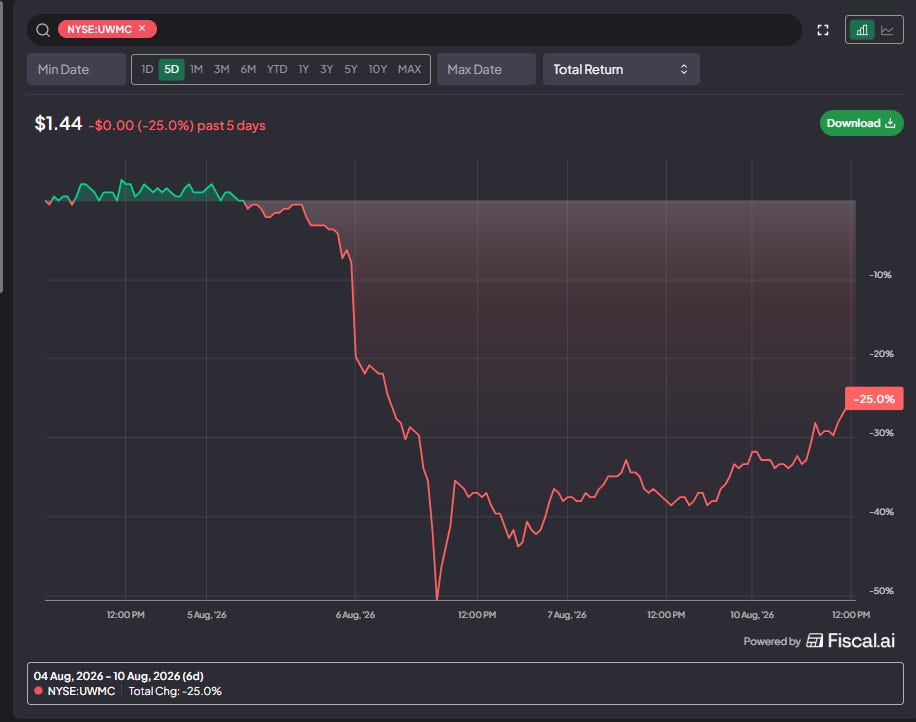
Last week, UWMC announced ugly Q2 earnings alongside a big new capital raise. The headliner here is a ~$450m net loss driven by ~$600m in derivative losses. That massive loss caused leverage ratios to explode higher; in response, UWMC suspended their dividend, raised ~$1.6b of prefs (on very expensive terms) from Oaktree + the CEO’s family, and will hold a $400m rights offering (backstopped by the CEO + Oaktree).
The surprise raise saw the company’s stock plummet, though it has regained some of that ground. As I write this, the stock is trading for ~$1.50/share (versus the ~$5/share it was trading when they agreed to the TWO deal in December!).
What’s interesting here isn’t the capital raise (though the capital is very expensive)…
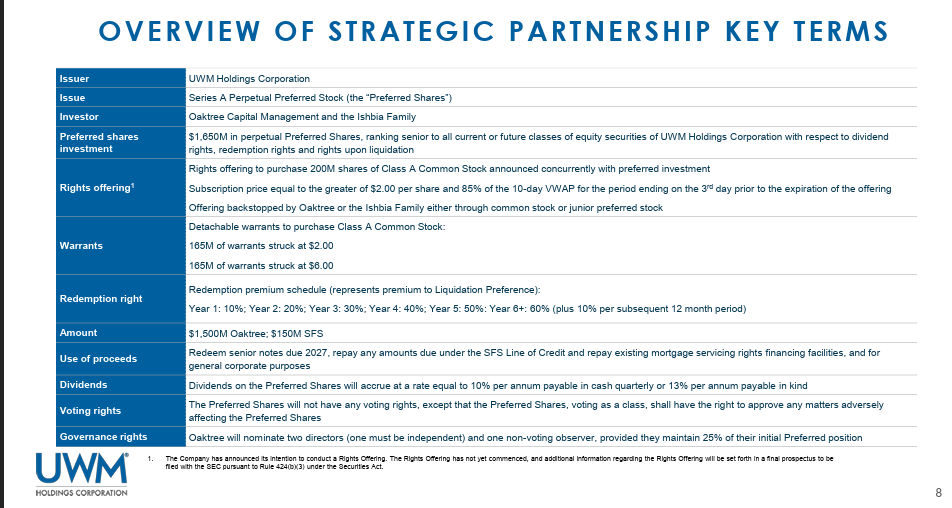
What’s interesting is the reason UWMC is giving for that ~$600m derivative loss. According to UWMC, they put a massive hedge in place when they had a deal to buy TWO. UWMC then took a bath on that hedge and lost out on TWO and thus got hit with a double whammy of losing on the hedge while not getting the gains on the asset they were allegedly hedging. Here’s how the CEO described it on the call (emphasis mine):
Let me go into the hedge loss because I think that’s a handful of other questions here. Can you please explain the hedge loss, what caused it and how investors should think about it?
So listen, hedging in general in the mortgage industry is expensive. And it’s something I actually don’t believe in, in general. We have never hedged our MSR, I say never. We don’t traditionally hedge our MSRs. Our origination machine is so big and strong that if the rates drop, you’ll lose MSR value and equity, but you’ll do so much more business that you’re good. And if rates go up, your MSR values go up and you do less originations, but your equity goes up. That’s kind of how we’ve always played it.
Well, when you’re going through and acquiring a company like Two Harbors and a massive MSR book, then our MSR book became double the size of what we’ve always managed. And therefore, it created a little more risk. So when we did put a hedge on to protect against that risk and then a lot of things happen.
Let’s just be real with whether it’s a war, a lot of different things that happened that created the 10-year to go up -- and then obviously, the Two Harbors transaction went away. And so a confluence of events that created a hedge loss. We hit a certain risk threshold that I said we’re not going to continue hedging regardless because we didn’t want to have more of an equity drain, and we took the hedge off. And of course, that’s the strategy that we’ve always had is let’s not hedge, let’s run the business effectively.
Once again, Oaktree has a strategic perspective on this, and I’ll go through that with them after this process and whether we hedge going forward or not. But once you have $3 billion of equity, you’re really not at a risk of the MSR values go down $400 million for this quarter or go up $400 million, it’s less relevant. But when you’re hovering around $1.5 billion or $2 billion, it becomes a little bit more relevant. And so that became an issue. We hedged -- and it was a onetime event, to be honest with you, because of Two Harbors, we were overhedged, if you think of it that way, protecting against the Two Harbors transaction. The market moved against us, and it’s a onetime event that won’t happen again. We feel like our hedging policies are much stronger now, but also we’re not acquiring another company that has an MSR book like that, at least that’s not the plan of now, and we know how to handle it differently going forward.
On the surface, that sounds reasonable. UWMC put on a big hedge, unexpectedly lost the asset that they were hedging, and thus got hit with a double whammy, right?
But here’s the thing: TWO broke their deal with UWMC in late March. UWMC reported the massive hedging loss in Q2, which runs from April to June. In other words, UWMC is saying they took a $603m hedging loss in Q2 hedging a TWO deal that they were no longer under contract for. And UWMC knew they were out; if you read TWO’s merger proxy with CrossCountry, it notes that UWMC gave TWO the wire instructions for their ~$25m break fee on March 31 (and TWO subsequently wired the money).
So the whole thing is just extraordinarily strange on a host of levels. UWMC got the break fee on March 31 (the last day of Q1) and then just sat on that fee for the entire quarter while their hedges were moving against them? What were they doing?
The obvious defense is that UWMC still thought they were going to win TWO. They were back in with a $12/share offer in late April and a $12.50/share offer in May, so you could argue they kept the hedge on because they expected to own that MSR book after all…. but I think that answer is even stranger!!! Under that version, UWMC desperately tried to re-engage with TWO after letting their first bid lapse and trashing the company and management on the way out. It makes them look like petulant children who are in over their heads. And by the CEO’s own telling, they didn’t take the hedge off when the deal went away; they took it off when they “hit a certain risk threshold.”
It also raises the question of how UWMC has been communicating with the market. UWMC reported Q1 earnings in early May; they noted “rates went up in March, and they've gone up even more in April”, but they don’t note anything about a massive hedging loss. They do note that their leverage ratios “are a little bit of an anomaly based on -- and same thing with the liquidity number based on some trades we have out there to help balance the MSR book,” but they don’t mention some massive hedge to cover the TWO bid or that they have anything out of whack. In fact, they say that the leverage ratios have “already come down a little bit now,” that they have “extremely experienced capital markets team” handling it all, and they talk about how they don’t really want to give UWMC stock away at these levels. It’s pretty hard to square how they talk about the environment and their balance sheet / value with the results they reported and the desperate capital hole they found themselves in.
Perhaps I am missing something. Maybe the hedges were so illiquid that UWMC couldn’t get out of them (though if that’s the case I’d suggest the hedges were very poorly designed to begin with). Or perhaps there’s some other reason they held on.
I don’t know. But UWMC is a wholesale mortgage originator and servicer. Those are businesses that operate on a whole lot of leverage and are very sensitive to interest rates. UWMC’s Q2’26 balance sheet shows ~$17.9B of assets against $985m of equity; that’s a little over 18x leverage. Admittedly, that’s due to the hole left in their balance sheet by the hedging loss, but even in normal times this is a business that runs with lots of leverage. When you’re running that levered, you have to be very disciplined at hedging and maintaining risk in order to survive through a cycle. For UWMC to lose that much money on a hedge for an asset they had already lost calls into question the trustworthiness of management, the competence of management, or perhaps both.
I have no horse in this race, but as someone who follows a lot of quirkier M&A news and a lot of lower quality companies that trot out some really outlandish excuses for awful results, the whole saga was right in my wheelhouse and I wanted to put something up on it!
PS- as I was wrapping this article up, news broke that UWMC is suing TWO for $500m over the failed deal. As someone who has followed a lot of deals, that suit seems like a huge hail mary…. but I’m ready to get my popcorn out!
A future proxy filing would reveal Company C to be CrossCountry, who eventually won the TWO deal.
I guess you can buy BNCC as OPFI is crashing today. I feel they should find a better suitor