
OpanAI launched the short-form video app Sora this week. It’s basically AI generated TikTok videos. On release, the app basically instantly climbed to the top of the app store, and the company has noted they hope this is the “GPT 3.5 moment for video”.
The videos the app can make are really cool1, but there are two really interesting threads that I think are worth pulling on from an investing angle. Both of the threads relate to IP; they are:
Upside (both legal and financial) for legacy media?
Tail risk for Netflix?
Let’s start with the first: upside for legacy media.
I could see two angles where Sora plays really, really well for legacy media.
The first and most obvious is legal. Sora launched with an “opt out” model for IP holders. This meant that if you owned some type of IP, you needed to proactively tell Sora that you did not want them to use it. For example, if Disney didn’t want videos of Mickey Mouse get generated on Sora, Disney would need to proactively tell Sora not to generate them.
OpenAI is already somewhat backtracking on this stance, but even with the backtrack I just don’t see how OpenAI isn’t exposed to enormous legal liabilities here. YouTube has managed to beat copyright infringement claims in the past, but only because they’ve been very active in removing videos that infringe on claims (if you post a clip with more than a few seconds of a song or a TV show that’s just casually playing on a TV in the background, YouTube will be pretty quick to take it down).
I’ve done a lot of research in drug IP litigation; in drug IP litigation, there’s a thing called “treble” damages that are meant to deter egregious violations. So if you ignore my patent and launch a drug, and I lose $100m because of your drug launch, if I sue you and win you’ll need to pay me $300m in damages if the court finds you willfully ignored my patent in launching.
I’m unsure how an “opt out” model isn’t exposing OpenAI to something similar to treble damages here (and, again, OpenAI might be thinking that too; they seem to have quickly backtracked to opt-in). But, even assuming the new guard rails work and Ip isn’t infringed going forward, it feels like OpenAI has a lot of exposure here. They basically used an open buffet of other people’s IP for ~72 hours to make their new app viral / successful, and even without that OpenAI is very clearly using a ton of copyrighted material to train their models.
Let me give you one very silly example: CNBC had an article quoting AI Sam Altman saying “I hope Nintendo doesn’t sue us,” and I’m a big fan of all things Mario…. so let’s use Mario as an example. I searched “Sora” on twitter I was pretty amused by this video of Mario getting pulled over in his Mario Kart and then fleeing from the cops (as well as this follow up video that added some Mario Kart music to it). That’s a pretty amusing video… but Nintendo is famously extraordinarily protective of their brand and IP. Do you think they’re thrilled to have a video of Mario running from the cops going viral?
OpenAI just raised $6B at a $500B valuation. That’s double the EV of Disney and almost 5x the combined EV of Warner Brothers (which owns HBO and the DC Universe, among many others) plus Paramount (which owns Spongebob, South Park, and plenty of others as well!). Disney and Universal are already suing Midjouney for using copyrighted images to train its software. OpenAI / Sora’s opt-out model kind of take that suit to another level…. how much value did ripping off popular IP in order to get Sora to go viral immediately create for OpenAI? $500m? $5B? $50B? I don’t know…. but I’d suggest it’s a literal fortune, and I think could be a lot of IP holders looking at that launch and saying “that doesn’t happen without our IP being utilized without our permission.” If a judge agrees, and you’re talking about treble damages on a viral AI app in today’s market…. well, that could create very interesting upside for these media companies!
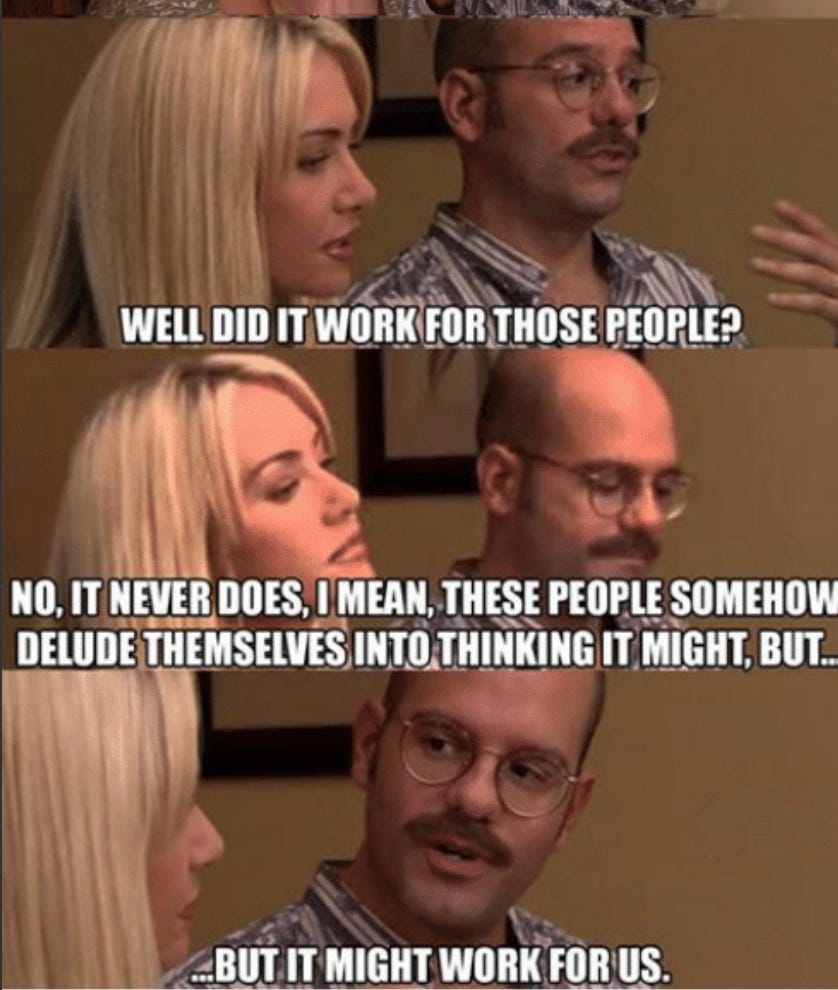
Is that an investment thesis for the legacy media companies? Maybe one day, though I will note that the history of companies having legal upside from suing big tech companies can be pretty accurately summed up by one meme:
However, there is another interesting angle to Sora. As media has becomes more fragmented, it’s been harder and harder for media to break through in a lasting way. That doesn’t mean it’s impossible (see the recent success of KPop Demon Hunters), but for some reason legacy media from the pre-streaming (or early streaming) days has remained in many ways more relevant than new releases. You can see this in the continued success of things like The Office, Suits, South Park, etc. on streaming, or you can just look at the top streaming movies right now and get a good feel for that:
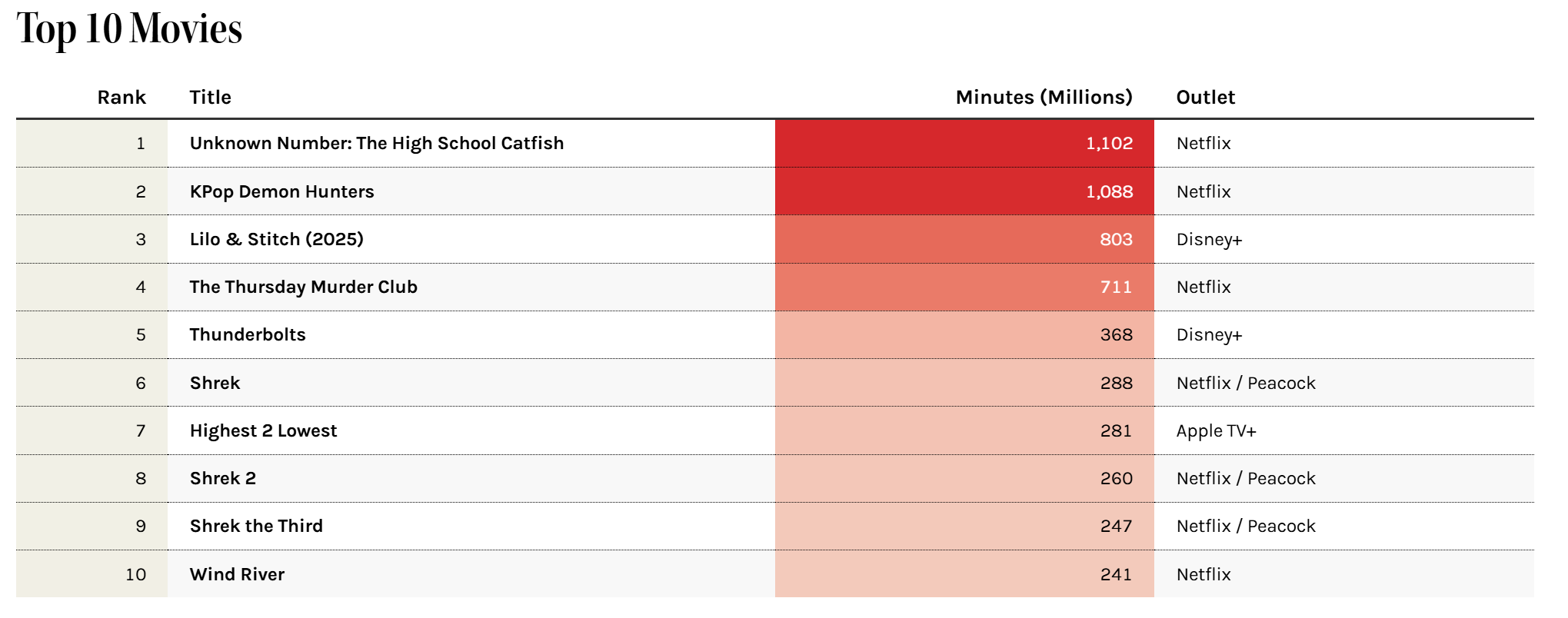
Yes, the top movies are dominated by new releases, but behind that you have Lilo & Stitch (a remake of existing IP), three Shrek movies (which are all 20+ years old), and for some reason a ~10 year old neo-western (Wind River).
Right now, Sora can make episodes of your favorite TV shows that look like the real thing (though the plots are kind of nonsensical). Imagine the continued improvement in AI and run it forward five years; if AI can custom generate you videos of your favorite shows, does legacy media brands capture enormous market share.
Let me sidetrack for a second: one of my favorite shows ever is Firefly, the cult classic that was horrifically mismanaged and unfairly cancelled after just half a season (yes, I am biased2). I hadn’t watched it in over ten years, so I recently made my wife rewatch it with me. Now, I don’t watch a ton of TV (it took my wife and I three months to with just 14 episodes, and that was fast for us!), so choosing to rewatch those episodes took up a lot of valuable “watching time.” Imagine a world where I could ask Sora to write 30 episodes to finish the story and all the plotlines. Or I really loved Parks and Rec; imagine a world where I asked Sora to write a new season set in the modern day. If Sora could do a reasonable job of those requests, I could almost guarantee I’d go for that every time versus starting new series.
What I’m trying to drive to is this: legacy TV has already shown an interesting hold of mindshare in media; one of the reasons you see so many reboots and sequels is that media companies find it incredibly difficult for new IP to breakthrough the noise. If AI is going to allow us to infinitely spin up stories in IP that we already love, is that a bull case for existing IP? We’ve seen something similar happen in music, where the rise of streaming has significantly increased the value of back catalogues. Obviously music is much different than TV shows / movies, but I’m just noting there is precedent for “old” media taking an increasing amount of mindshare / profits as industries mature3.
If something like that happens, it’d be an interesting bull case for legacy media. Suddenly all of their back catalogue becomes hugely valuable as fans who love properties can spin up infinite variations of their favorite shows. HBO’s getting buzz over a reboot Harry Potter show; what if instead they were offering you the opportunity to stream a twenty episodes following Harry 20 years post-Hogwarts as he worked as an auror, tracked down magical crimes, and dealt with some post-Voldemort PTSD? What if HBO offered an alternative Game of Thrones that let you change key plot points and see how the series would have developed (“Game of Thrones but Rob Stark survives the Red Wedding”; “Game of Thrones if John had lost the Battle of the Bastards,” etc.)?
I’m not saying those shows would be perfect…. but run the AI forward a few years at the current growth pace and you could definitely see how an AI plus maybe a few writers could spin off infinite different twists on a story very quickly. Obviously there would be all sorts of legal issues to sort out with that (likeliness payments, etc.), but it’s an interesting world to think about.
Eyeballs are a zero-sum game; any time you spend watching one thing is time you're not watching something else (i.e. when you watch an old episode of the Office, it’s time you’re not watching an NFL game or the new season of Wednesday). Which brings me to the last piece of my thesis: Sora is kind of the first time I’ve seen a credible bear case to Netflix in years.
I’m not saying that’s right, but for all of Netflix’s strength it is decisively short on this “legacy IP” ownership. Netflix is incredible at distribution, but many of the hits that they’ve spun up are actually legacy IP that breaks out on their distribution (Suits is the classic example, but you can find nearly infinite examples of old school TV shows moving to Netflix and seeing their popularity explode). If you move into an “AI creates individualized content” world, it seems to erode all of Netflix’s scale advantages and play strongly into their disadvantages.
I’m not saying that’s happening today, tomorrow, or next year. As impressive as AI is, it’s clearly still years away from creating mass market hit shows. The Sora videos can be entertaining for a quick hit but they get pretty nonsensical if you expand them out at all.
But AI is advancing rapidly, and it’s absolutely going to flip a bunch of media businesses upside down. It’s worth thinking about who stands to benefit from the flip…. as well as who could be left behind.
I’ll note I don’t have an access code and I’m too old to spend more than one minute trying to get one, so I haven’t directly played with it myself
Firefly’s cancellation and subsequent movie set an interesting course for how media would develop over the next 20 years!
And note this doesn’t mean new stuff doesn’t come along; there are plenty of new stars in music! But it does suggest that older catalogues have increasing value and there are probably less new stars going forward.
If you need a Sora invite code, happy to send one of mine over. Just let me know where to send it. Love your blog and appreciate your insights!