
Last month, Zohran Mamdini won the Democratic primary for mayor, and that (probably) puts him on track to be NYC’s next mayor (as I write this, polymarket has him at about 70% to win).
I have friends who are mortified by Mamdini’s primary win; I have friends who are elated. For the purposes of this post, I take absolutely no view on Mamdini’s (or any candidates’) politics (though, if you really want to know, I basically agreed with the NYT’s rec, which is uncommon but certainly not unheard of when it comes to politics).
Instead, I wanted to talk about the one interesting investment takeaway I had from the primary. And, no, it’s not “short NYC / long Miami real estate” (though it’s quite possible that is a good trade; in fact, it’s one I wouldn’t be surprised to make personally in the near future!).
The most interesting thing to me is how at risk I think political advertising revenue is for a lot of the media companies. This presents risks to a lot of companies, but in particular could prove a near-fatal problem for local broadcast affiliates (like Nexstar and Gray).
Let me back up a bit: local broadcast affiliates are the companies that control your local Big 4 network (NBC, FOX, CBS, ABC). In most of the major cities (like NYC), the network controls their affiliate (i.e. Disney owns both ABC and the local ABC affiliate). But, due to legacy regulation, most smaller cities have an affiliate own / control their network (Nexstar controls the ABC affiliate in Nashville, for example).
Local affiliates have served as a mini-obsession of mine for a long time; largely because they neatly wrap up my interest in M&A, regulation, media, financial engineering, and hidden assets in one really interesting bow. Given that interest, I tend to write them up once or twice a year (my latest write up was on the heels of my Tom Wheeler interview) even though I haven’t ever taken a substantial position in one.
But what does all of that have to do with NYC’s democratic primary?
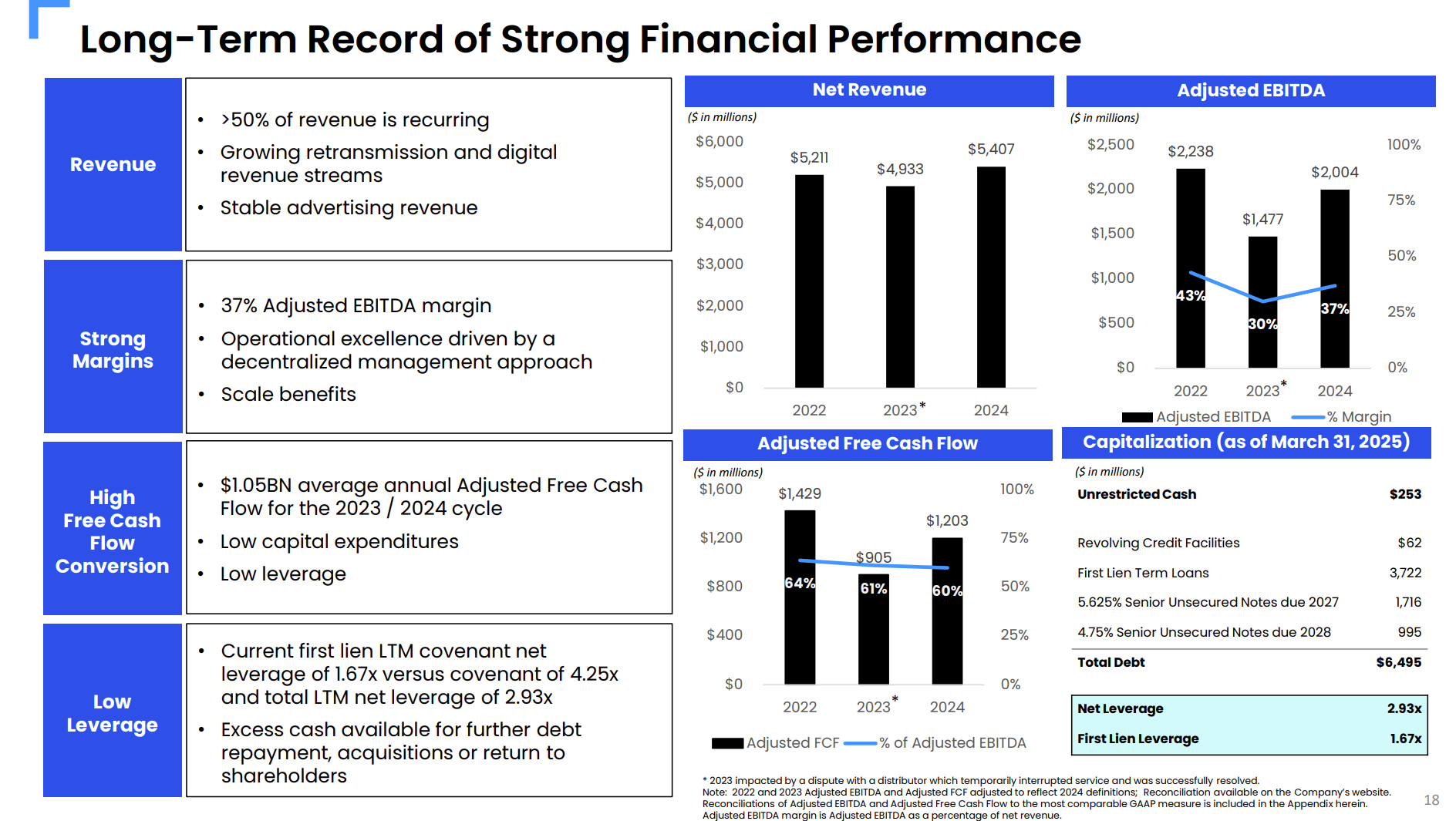
Local broadcasters are huge beneficiaries of political advertising. Just consider Nexstar; their political advertising revenue will swing by >$400m from off-cycle years to on-cycle years (i.e. from odd number years without big national elections to even years). Given incremental ad dollars come with massive margins and NXST does ~$1B in annual free cash flow1, those incremental political dollars are massive and meaningful windfalls for the company (and all broadcasters!).
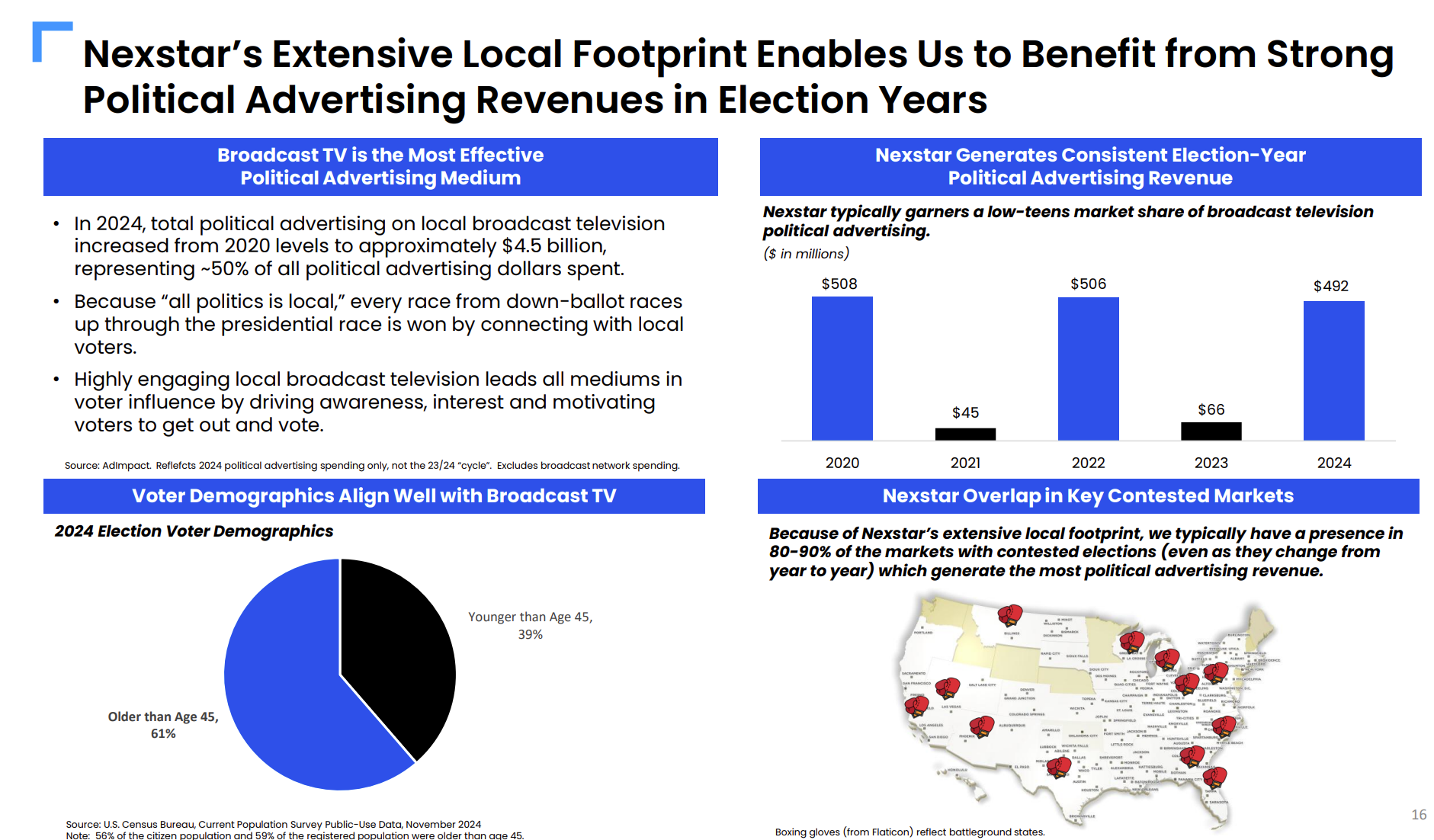
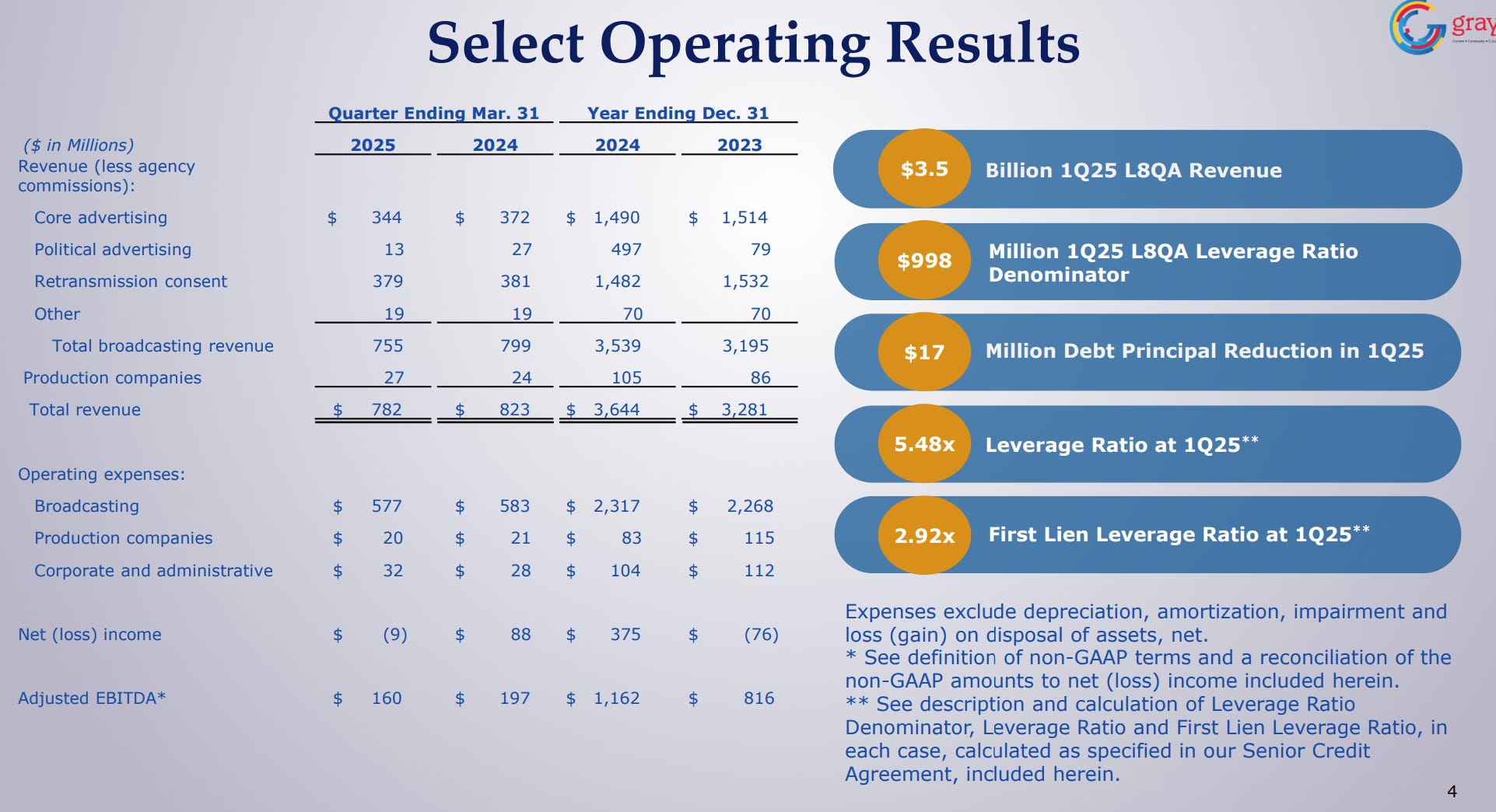
In fact, the political revenue swings are so large that most broadcasters adjust for them in their earnings / valuations. For example, if you look in the screenshot below, NXST gives a two year average annual free cash flow number in order to adjust for the impact of political ads (their multiple would swing to wildly if you valued them on an on year number one year and an off year number the next), and broadcasters generally will report (and lenders generally accept) an “L8Q” EBITDA number versus an “LTM” number common for most companies (in order to account for political swings, companies will average out their last 8 quarters of earnings instead of the last year like most companies). GTN does exactly that “L8Q” presentation in the screenshot below:
Why do politicians spend so much money on local broadcasters advertising? I’d argue two reasons: the practical argument, and the traditional argument:
The practical argument: As Nexstar notes, “all politics is local”…. and the broadcasters will argue that there’s no better way to reach locally than broadcast advertisements. Think about it: if someone is watching the local news, you know a lot about them…. including that they’re interested in what’s happening locally! Who better to hit with an advertisement arguing a particular politician will be good / bad for the community?
The traditional argument: For the past ~50 years, there has been a very standard playbook for being a successful politician (especially locally). Launch your campaign, raise a bunch of money, hire a staff, and then blanket the local airwaves with advertisements. The more money you raise, the better…. and, because there’s really a limit on how much staff you can hire / use, every incremental dollar you raise is basically an incremental dollar that goes towards local advertising. Yes, there have been some updates to the strategy in the modern era (use facebook ads!), but that’s basically the way campaigns have been run for the past 50 years and any campaign manager you hire is going to have grown up using that exact model successfully, so that’s exactly what they’re going to steer you towards.
I’m not naive and saying Mamdini is the first candidate to run a grassroots campaign and upset a well known, well funded opponent; there are countless other examples through political history. But I would suggest that Mamdini’s campaign drives home the lesson of recent politics: earned media and online buzz is only getting more and more valuable, while traditional ads are having an increasingly hard time cutting through the noise.
If you believe that thesis, that has stark implications for local broadcasters. Parties and campaign managers are either going to start recruiting and leaning into earned media on their own, or their legacy candidates will get run out of town / beat in primaries by more modern candidates who adapt their new strategies. Either way, the traditional “raise a war chest and spend it all on local TV advertisements” strategy is going to get replaced, and with it a huge source of local broadcasters value.
That’s a scary thought for local broadcasting companies…. however, I don’t think the downside ends there. If you’ve read any of my recent pieces on the broadcasters, you know that I’m concerned that they are feasting on a legacy business model that would be very easy to cut them out of. Local broadcasters would take huge issue with that worry; they’d say the provide a hugely valuable product in their local news offering (alongside other local programming). I’ve always been skeptical of that argument for a bunch of reasons (local newspapers made the same argument and that didn’t protect them, national politics are increasingly dominating local politics, etc.)… if I’m right and local political advertising is increasingly ineffective, then it might be a sign not just that there is an issue with advertising in that medium but also that the medium overall is less valuable than people have traditionally thought / that people aren’t connecting as much with local programming as much as they used to. Remember that the local affiliates are taking in huge revenues thanks to legacy regulation and their position in the cable bundle; if they’re ever forced to renegotiate that position (either due to regulatory changes or because the cable bundle breaks entirely) and there’s evidence that people just don’t value the local news as much as they used to (even if they watch it quite a bit!), then that would be a disaster for the economics of the local broadcasters.
Anyway, no current position either way in the broadcasters. In fact, I’ll admit my bias: I’m always tempted to buy them. Again, they have potential hidden assets in their spectrum, they’re insanely cheap, generate huge cash flows, return oodles of cash flow to shareholders, and could be a huge beneficiary of deregulation / an M&A wave. That checks basically all of my boxes…. but I continue to worry that there’s enormous tail risk to the business model, and that one day that tail risk will get cashed in and the companies will collapse. And when I see advertising in the medium getting more and more ineffective, I worry that’s a sign that day of collapse is closer than most people think.
Adjusted for the political seasonality I’m about to discuss!
Political rev moving online is accelerating. Mamdani ran a strong campaign. Broadcasters still sitting around thinking about how to cut cost and praying for NFL season to start - not a good look.
somebody is gonna make a lot of money selling politicians on bot followers.
grift economy bumps upward.