
I’ve written extensively about Muse and consumer agents over the past few weeks (including a plea for people to actually try them!). I continue to experiment and play a lot with them; I will admit that my thoughts on them do wax and wane by the day from “damn, these are going to change everything” to “these are really cool, but it’s just going to make our lives a little easier, not reshape the consumer economy as we know it.”
As I’ve continued to play with them and think about how they’ll impact both the investing landscape and our lives, there are three somewhat interconnected thoughts that have just been popping into my head over and over. And, because they keep popping in my head, I figured I’d put some (figurative) ink down on paper on them. Those three thoughts are:
Incentives for lack of ethics / guardrails in consumer agents
Short term gain, long term pain: the prisoner’s dilemma for retailers versus agents
OTAs and the “obvious” disruptive shorts
Let’s dive in:
Incentives for lack of ethics / guardrails in consumer agents
The two agents I use the most are Muse and Claude Cowork. I mainly use Muse for personal stuff and I use Claude Cowork for business / investing stuff. I do dabble a little bit with ChatGPT and I have downloaded Grokbot, but for my purposes those are the two main ones.
One of the main differences I’ve noticed between Muse and Claude is that Claude is very strict on ethics. For example, if a website asks you to confirm you’re a human, Claude simply won’t do that for you. In contrast, Muse will either try to do it for you automatically or ask you if it should try to fool the website.
That’s a small example, but it applies to other things. For example, I once asked Claude to search a Substack (that I paid for!) for past references to a particular stock and then create a timeline with a summary of what was said on that stock and a link to the article. Claude told me it wouldn’t do that, saying it was worried about violating copyright law. I got into an argument with Claude (“I’m paying for this Substack; I’m just asking you to summarize and link to the mentions, and this is just for my internal notes and research and reference! How can this be copyright violation in any way?”) and it eventually did it for me, but it was a pain and put up a ton of barriers. In contrast, when I asked Muse to do it, it just went off and did the task no questions asked. That’s a little bit of a niche example, but it applies across the board / all the time; there are things that Claude simply won’t do or resists doing that Muse is happy to do.
For most of the last few years, the AI race has been driven by being at the frontier. And maybe that is the path to riches; perhaps whoever can build a recursive self improvement AI first pulls away from everyone else and wins the AI race for all time. But Muse is winning a lot of market share not because it’s the best model but because it’s really easy to use and because it will basically just try to do everything you ask it to without question.
All of the AI players are competing for enormous prizes that are existential (both in a business sense and possibly for all of humanity). If one way to gain an edge in winning the “AI race” prize is to lower standards / just do stuff, eventually every lab is going to be forced to do that. It’s a very prisoner’s dilemma type thing; the moment one lab does it, all labs have to do it or they get left behind.
As a consumer, in the short run that’s pretty cool. How awesome would it be if an AI could click all those “are you a human” boxes for you across twenty different websites and automatically build a dashboard that let you manage your finances or your social life or something really easily?
But, in the long run, you could see a lot of reasons to be worried if each lab is incentivized to lower standards like that.
Speaking of prisoner’s dilemma….
Short term gain, long term pain: the prisoner’s dilemma for retailers versus agents
This may be anecdata, but I feel like I’ve seen an increase in the times Muse tells me “I can’t interact directly with that site…. want me to take control of your browser and pretend to be you and try anyway?” (yes, another example of the ethics / guardrail issue mentioned above). That issue started with Amazon, which banned Muse almost the moment it rolled out, but I think it’s getting wider.
That ban creates an interesting prisoner’s dilemma for a host of businesses: consumer agents might destroy your business in the long run, but in the short run if every competitor in an industry bans agents then any one competitor could get a leg up by catering to agents.
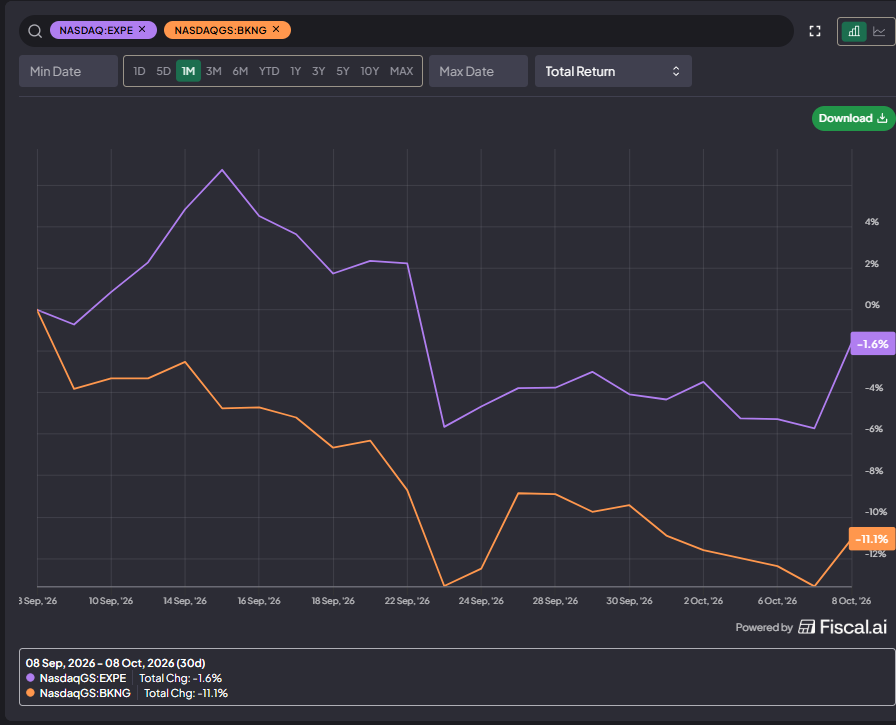
A simple example will illustrate this: imagine that Expedia and Booking both think Muse is an existential risk to their business and refuse to work with it. They may very well be right…. but if a ton of consumers are using Muse, either Expedia or Booking could capture a lot of business in the short term by lifting the ban and being the de facto agent of choice for Muse. Yes, they’re risking their existential future, but in the short run the returns would be glorious…. and, indeed, Expedia has done an integration with Muse already! And it is perhaps worth noting that EXPE’s stock has well outperformed BKNG’s stock over the past month as consumer agents have taken off; obviously one stock does not make a trend, but that’s exactly the type of outperformance you’d expect to see from a company that “took the deal” and stabbed everyone in the back in a prisoner’s dilemma!
You can imagine that issue across a host of businesses. One I like to think about is department stores / retailers. Obviously, broadline department stores are struggling; you don’t need me to pull up a chart of JCPenney or Sears to prove that to you (in fact, I can’t because they’re bankrupt / nonexistent anymore). But, for the remaining department stores, agents are clearly a disaster for their already under siege business. If you need undershirts or a pair of workout shorts, why go to macys.com and buy them when you could just ask your agent to search the internet for you and buy them from whoever is cheapest? So, if you’re Macy’s, you can’t work with an agent because it will kill you…. but if none of your competitors will work with them, maybe you can get one last windfall by stabbing them in the back and being the only one to work with agents?
In the short run, I think a lot of businesses are going to be blocking / banning consumer agents. But, in the long run, they’re going to have to work with them. Either the consumer agents will figure out ways to find end arounds to the blocks, or a competitor will realize they’re in a prisoner’s dilemma and stab everyone in the back to capture the profits1.
Which brings me to my last point….
OTAs and the “obvious” disruptive shorts
I have listened to a lot of podcasts from people who are building consumer agents (mainly the Muse and Instinct teams). Invariably, when asked about how to use consumer agents, the first use case mentioned will be using agents to save money on subscriptions or to easily plan and book travel.
I’ve talked to longs on EXPE / BKNG. When I do, they’ll mention a lot of things: there’s a long tail of European hotels that the OTAs have spent years cultivating that consumer agents won’t be able to reach / displace OTAs from easily, consumer habits are really sticky, the OTAs are taking a small fraction of the value and convenience they provide, in the short run agents will work with the OTAs and might even benefit them, etc.
I totally get all of those arguments2… but, if I just eyeball Expedia and Booking, they’re trading for like 15x P/E. That valuation requires the business’s cash flows to have a very long life; for a business trading at a 15x P/E and growing in the mid to high single digits in the short term, ~80% of a business’s value comes from cash flows after year five in a DCF3.
Consumer agents are exploding in popularity, the companies behind them are investing billions of dollars into the product, and the first use case the people who are making them blurt out is “Use them as a super OTA!” I’m not sure how any investor looks at that fact pattern and thinks “yeah, I can generate alpha by buying an OTA and betting these cash flows are not just going to have a long life, but going to have a long life well above what the market is forecasting.”
Now, markets are competitive, and consumer agents have been with us for ~a month; that’s more than enough time for markets to digest a threat this obvious.... yet neither BKNG’s nor EXPE’s stock is showing any type of existential worries; again, both trade at ~15x and EXPE’s stock is basically flat on the year!
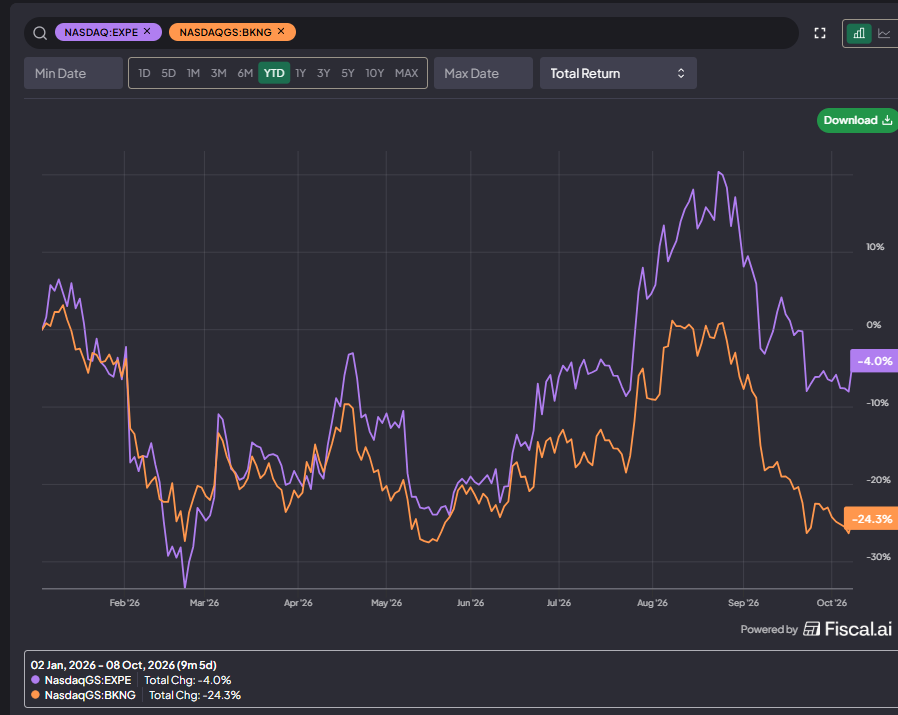
It’s just hard for me to square “every consumer agent is targeting travel as a vector and raising billions” with “OTAs are trading like the future is rosy.” I realize that Google Flights and a host of other competitors never took off, and that the consumer agents might take a little more time / handholding to book a simple trip than an OTA right now…. but travel is clearly a killer use case for agents, and it just seems wild to me that the market is yawning here.
This is a tangent that I’ve offhandedly mentioned before, and I could and should probably build a post around this point…. but, if you play the “everyone needs to work with agents” point out to its conclusion, consumer agents are just wildly, wildly deflationary as they will eat into basically every business’s margins through price comparing and constantly negotiating. In fact, I can’t think of a single consumer facing business that consumer agents are broadly bullish or margin supportive for!
Actually, I intentionally didn’t use the best bull argument for the OTAs: EXPE and BKNG have billions of proprietary data points from historical consumer interactions, so AI creates existential risk but could also create a permanent moat if that data turns into a travel flywheel in some form. That could be true, but I’d suggest at 15x P/E the downside risks far, far outweigh the upside ones. I also would come back to basics: right now, EXPE and BKNG “control” the consumer and the distribution process; in the future world I’m talking about, the AI agent (like Muse) owns the consumer. I can’t think of a single product that has lost control of the consumer and then been worth more on the backend. Ask STRZ and the rest of the cable bundle how licensing content to Netflix and letting them have control of the consumer worked out!
Lots of different assumptions on growth rates, reinvestment rates, interest rates, etc. could get you to different numbers here. But 80% is in the right ballpark!
Great points, Andrew! On the flip side of the OTA argument, is that a positive for Airbnb in that they have lots of unique locations? I have not looked at the valuation and I’m not suggesting it’s a buy today, just in general principles. I would think their push into “experiences” could be less fruitful if agents can build the itinerary/package for you, unless Airbnb becomes the first stop even for agents. Agents are known for taking the easy route, right?