
Back in the early to mid 2010s, fundamental investing ran into a problem: interest rates were low, and so were stock prices. The two shouldn’t be low at the same time, and it was causing issues with DCFs.
It’s an issue that I’ve been thinking about a lot recently, as I worry we may be about to run into the reverse problem: high stock prices with high interest rates that break DCFs.
What do I mean by breaking DCFs? Technically, the correct way to value any business is to run a DCF on it. You figure out their future cash flows, discount them back to the present, and presto! You have your firm’s value.
Now, it sounds simple in theory… but if it was that simple then anyone with a spreadsheet would generate alpha! In practice, valuing something is much harder. The real skill is getting the assumptions right: figuring out the near term cash flows, figuring out when to set the terminal cash flow number, and figuring out the correct interest rates. It all sounds simple in theory, but in practice it’s devilishly hard.
Of those three major assumptions, it seems like the simplest should be setting an interest rate number. After all, the treasury market is the most liquid market in the world; using the treasury rates plus some equity risk premium (ERP) seems like an obvious choice.
And that is the theoretically correct answer! But, as I mentioned at the top, there was a problem in the early 2010s: interest rates were really low. The 10-year treasury floated around a 2% interest rate for most of that time period. An interest rate that low would suggest stocks should have been much higher than they were if we assumed historical average ERPs.
So practitioners were running into a problem: if you took the market interest rates and used a long term average ERP when valuing basically any company, your model would spit out a fair value that was way, way higher than the current stock price.
Of course, there is a solution to that problem: use a higher ERP number. I’m about to get a little wonky, but bear with me. NYU publishes a long term chart of ERPs; you can find it here. The long term ERP average is around 4.3%; from 2011-2015, the average ERP was ~5.75%. That’s a massive gap: stock indices would have been ~35% higher if the ERP had been sitting at its long term average around that time. McKinsey1 put it this way, “Given the low interest rates over the past 15 years, the typical large company should have traded in the well-above 20-fold P/E range since the Great Recession. But that hasn’t been the case. Median large companies have consistently traded in the 15-fold to 17-fold P/E range since the financial crisis—despite low interest rates during the entire period.”
Bottom line: the super low interest rates of the 2010s should have resulted in much higher market prices than we saw…. but stocks stayed at largely reasonable / low P/E multiples (for the most part) due to a higher equity risk premium.
Before getting to why, it’s worth dwelling on how much havoc that gap wreaked inside companies. Remember that all capital allocation is a game of tradeoffs. A company can buy back stock, pay down debt, or invest in capex. Which to do often depends on the stock price; if the stock is trading for a 1x P/E, the market is screaming for the company to immediately stop capex and buy back shares. If the stock is trading for 100x P/E, the market is begging the company to issue shares and ramp into capex.
In that way, the higher implied ERP created lots of issues for firms. If a company decided to use a long term average ERP instead of the mark to market number, a DCF would suggest the company’s stock was incredibly undervalued and they should buy back shares like crazy. If they instead used the higher ERP designed to back into today’s stock price, then they’d need to use the same high discount rates when evaluating capex (and thus need to pass on a lot of capex that would have been profitable at a lower discount rate).
Why didn’t stocks take off when interest rates were low / why did the ERP stay so high? I saw lots of arguments for why stocks were so low at the time; for example, McKinsey argued that interest rates were so manipulated by the government that the market simply didn’t trust / use government interest rates in setting multiples. I never liked that argument, but I think it’s an interesting one. It basically flips the ERP argument; instead of arguing ERP’s are at record high levels that may be unsustainable, it argues the ERP is at a normalized level and the interest rates are at unsustainably low levels. Outside of interest rates, I’ve heard people arguing that the market didn’t trust the sustainability of earnings (though, admittedly, this argument was made much more in the early 2010s when people were still worried about a double dip from the GFC). At a company specific level, I think there was a lot to be argued about the market putting capital allocation / management misalignment discounts on companies given some gargantuan pay packages that often did not require the stock to work to vest.
Over the past 10 years, markets have done incredibly well. The S&P 500 has done almost 15% annualized:
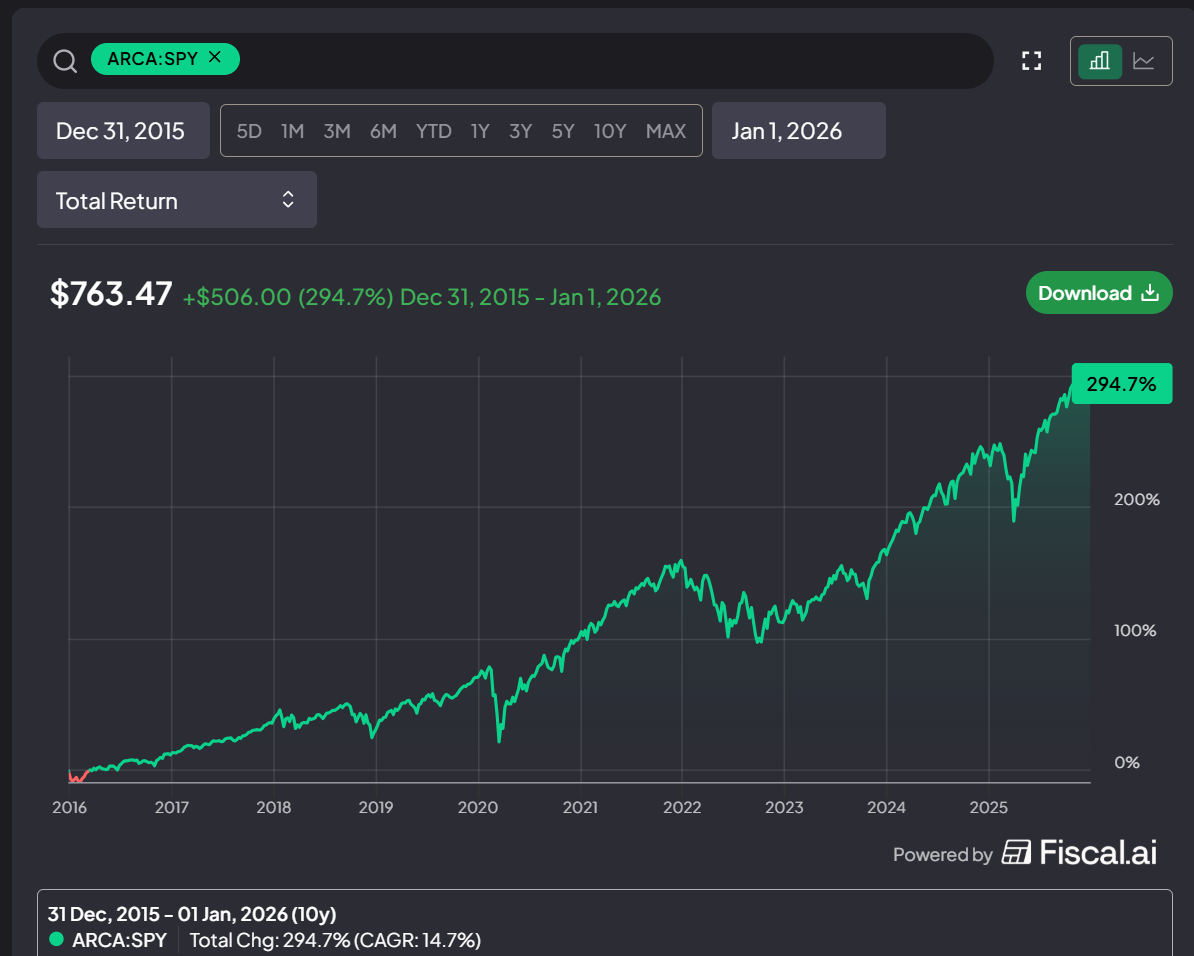
I’d argue a lot of the strong past 10 years for equity markets has to do with the really high starting ERP from 2015 (i.e., stocks starting cheap relative to rates). Yes, earnings growth has been very good, but the P/E for the S&P 500 went from the high teens in 2015 to ~25x by the end of 2025. That was an enormous tailwind for the market (and some of the more steady components of the S&P really benefitted; for example, Costco went from trading with a P/E in the 25-30x range to ~45x, and WMT went from a ~13x P/E to ~40x. Those P/E increases are even starker because they come despite rising interest rates. I don’t think either of those businesses has a materially different competitive moat today than they did 10 years ago; rather, I think investors have just come to underwrite their moats and terminal value with much more certainty).
Fast forward to today, and suddenly everyone is talking about rising interest rates. Treasuries are at multi-decade highs, and the treasury is suddenly intervening in the bond market to drive down interest rates. Despite the sudden rise in interest rates, stocks are sitting at all time highs. My fear is that the outlook for the next decade is the mirror image of what happened in 2015: then, stocks started depressed versus interest rates and rode a P/E expansion tailwind higher. Today, I worry stocks start with a higher P/E and get dragged down over time by high interest rates.
The all time highs in stocks today are not being driven by the ERP suddenly shrinking (as it was during the dotcom bubble). At the beginning of August, ERP sat at ~4.3%, right in line with long term averages (ERP touched 2% during the heights of the dotcom bubble). Instead, stock prices have remained supported by massive growth in earnings over the past few years.
So perhaps my fears are misplaced. Perhaps stocks are priced reasonably and I should be more worried about a cyclical washout / recession destroying earnings than I should about stocks starting at a lofty valuation.
Or perhaps the two are tied together: maybe low interest rates in part fueled the boom in earnings by providing cheap credit, and a rise in interest rates causes a double whammy of falling earnings and a drop in P/E? We’ve already seen something of a preview of that in the recent past: the ERP had compressed to ~4.2% on top of a ~1.5% ten year by the end of 2021. When rates ripped in 2022 (rates ended the year approaching 4%), earnings stalled out (S&P earnings grew <1% from 2022 to 2023) and stocks were crushed: the S&P dropped ~20% and the market’s P/E compressed from ~23x to ~17x as the ERP rose to almost 6%.
So what happens this time? I’m honestly unsure. But the more I think about interest rates, the more I focus in on what happened in 2015.
Time will tell.
Disclosure: I used to work at McKinsey for the authors of this article a long, long time ago!
One's DCF should be based on the real yield https://fred.stlouisfed.org/series/DFII10. While it is clearly above the GFC-COVID level, it is not dramatically so - and far less than one might assume by looking at nominal levels cited in the press. Not that one shouldn't panic now, but we are within the pre-GFC levels and the levels sustained over the last 2 years.
AI capex bubble bursts leading to lower stock prices and lower interest rates in the next couple of years.