
Football1 is a ratings juggernaut in the U.S.; it made up 92 of the top 100 rated telecasts in 2025.
Football has a lot of things going for it that make it perfect for a TV broadcast (natural commercial breaks, scoring plays that are rare enough that games are naturally tense, etc.), but one of the big things is how much strategy there is. On any given play, each team is making countless strategic decisions: run or pass? Shotgun or under center? Four wideouts or two? And there is no perfect answer; the right decision on any given play is impacted by endless factors (time left in the game, score, personnel, what the other team is doing, etc.).
That strategic variety doesn’t just make for entertaining games; it creates natural storylines and discourse, so much so that there’s a name for second guessing a team’s strategy after the game (Monday Morning Quarterback).
Contrast football to, say, chess. Chess can be a lot of fun, but there’s just not a lot of discussion. The number of moves is limited, and there’s always an “optimal” move (or a few optimal moves). You wouldn’t suddenly start moving your king erratically because the game situation demanded it or something.
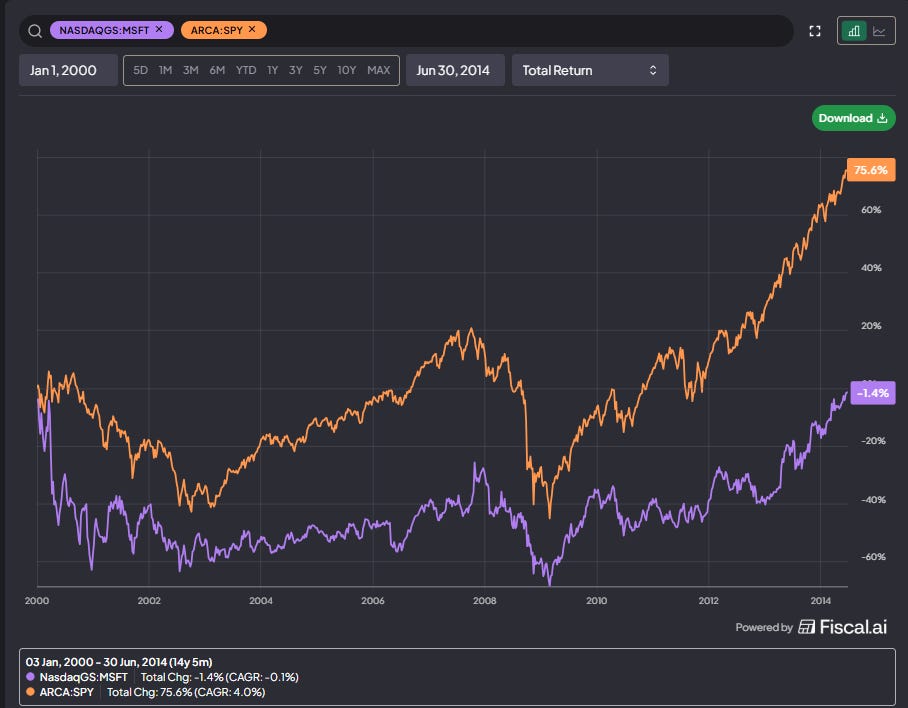
Investing is a lot like football in that way. Because we’re dealing with a lot of unknowns and the real world, there are no “optimal” moves. Do you want to buy great companies that are growing quickly? Sure! But price matters; Microsoft is a great company, but if you had bought them in early 2000 it would have taken you almost 15 years just to break even on your investment! It’s not like MSFT performed poorly as a business over that time; revenue grew ~10% annually and EPS compounded high single digits from 2000-20152, but it takes much more to grow into the ~70x P/E that Microsoft started the century with!
Anyway, the reason I’m writing this post is because over on Value Investors Club (VIC) someone put up a message titled “it’s the jockey, stupid” that noted they were a value investor and their biggest mistake over the years had been passing on businesses with good “jockeys” because the price was too high only to watch the business outperform as the good manager continually beat expectations. That post created a (somewhat) lively debate: some people suggested price matters, others suggested it’s better to focus on good businesses versus good management or good prices (one snarkily posted “it’s the business, stupid”), while still others chimed in suggesting focusing on founders3.
Again, nothing is guaranteed in investing. The answer to “low price versus great management versus good business quality” is generally “it depends.” How low is the price4? Something trading at 5x earnings is generally pretty cheap…. something trading at 0.5x earnings is much cheaper! How great is the management team? There’s a difference between having Steve Jobs (perhaps the GOAT CEO for his AAPL turnaround) and Eric Schmidt (who did a fantastic job at Google, but isn’t on anyone’s Mount Rushmore for CEOs). How great is the business? Home Depot is a very good business, but it’s got nothing on Google Search (the core business).
So all of those variables matter…. but industry context matters too! If you offered me the choice between a coal business run by a C+ CEO at 10x earnings and a similar coal business run by an A CEO at 50x earnings, I’m taking the cheaper one, no question (though, given we’re talking coal companies, I’d also be wondering why the multiples were so high!). That’s probably the right decision; Warren Buffett himself coined the line, “When a management with a reputation for brilliance tackles a business with a reputation for bad economics, it is the reputation of the business that remains intact,” so if you’re buying a commodity business like coal you probably just want absolute cheapness…. but switch from a coal business to a tech company, and I’m taking the more expensive business with the best management every time. Tech evolves so quickly and has such fat tails that the manager probably matters more; there’s a reason Myspace is basically defunct while Facebook is a giant today and and his name is Mark Zuckerberg.
So tech is a place where management matters more, right? Perhaps! But it’s interesting that the “tech at 50x earnings” example I laid out is basically MSFT in early 2000, and that didn’t exactly work out well. It’s also worth noting there are plenty of examples where brilliant management stepped into a tech business and failed anyway; Marissa Mayer was about as star a hire as Yahoo could have made, and all that talent couldn’t outrun the decline of the core business. And it’s not just tech! Ron Johnson looked like a genius building out the Apple Stores, and then he took over JCPenney and nearly ran the whole thing into the ground in under two years. When can a brilliant management outrun the yoke of a bad or declining business?
On the flipside, Buffett said business outweighs management…. but then how do you account for Elon Musk? Historically, you would have been better off literally lighting your money on fire than trying to do a start-up rocket or car company. Why? Because all of them would involve you losing all your money, but at least if you lit it on fire you’d do it quickly and save yourself the time and heartbreak of trying to build a business that lit all the money on fire anyway. But neither those base rates nor valuation mattered for Elon Musk… so is Elon just the exception that proves the rule?
Charlie Munger once noted that what made the market so difficult is it effectively operated on a pari-mutuel system (the better the horse looks, the worse the odds you get; in investing, the great jockey and the great business come with the price already marked up), but what’s so interesting is that the market offers you the ability to trade off so many different levers against each other. If you increase the “management” lever and demand better management, you generally pay a higher price. Ditto business quality.
So how do you decide which lever to push and how hard to push them against the others?
I’ll end this article the way I end so many of my articles: I have no good answers here! But that VIC post has wormed its way into my head and I’ve been thinking about it a lot, and I wanted to share those thoughts with you!
Given the World Cup just ended, I’ll clarify for my international readers I mean American Football. The World Cup was awesome though!
The EPS math depends on your endpoint; GAAP FY2015 EPS was dragged down by the giant Nokia writedown, so the exact CAGR lands somewhere in the 7-9% range depending on how you adjust for it.
A related argument noted VCs’ huge focus on founders and their belief that truly exceptional individuals / founders are what drive the majority of gains.
To clarify, low price means cheap valuation, not absolute low price in stock price terms!